
Part 139 Compliance
From General Aviation to Part 139: What Changes When an Airport Gets Its Operating Certificate
A general aviation airport needs a Part 139 Airport Operating Certificate before it can serve scheduled airline flights in aircraft with more than 9 passenger seats, or unscheduled ones in aircraft with at least 31. Getting one means an FAA-approved Airport Certification Manual, a set of written programs with training cycles and records, and aircraft rescue and firefighting on the field during air carrier operations.
Two general aviation airports have just made the move. The FAA announced a certificate for Washington Manassas Airport on August 31, 2026, the first in Virginia in 53 years, and for McKinney National Airport on September 24, 2026, the first in Texas since 2005 (FAA). McKinney’s first scheduled passenger flight left on November 11.
This guide is for airport managers, operations staff, and sponsors weighing or starting the same move. Each statement is labeled Rule (14 CFR Part 139), FAA (an FAA web page or news release), or Practice (our advice). It doesn’t cover TSA security requirements, terminal development, environmental review, or the business case for air service.
Which airports need a Part 139 certificate?
Part 139 governs airports serving “Scheduled passenger-carrying operations of an air carrier operating aircraft configured for more than 9 passenger seats” and “Unscheduled passenger-carrying operations of an air carrier operating aircraft configured for at least 31 passenger seats” (§139.1(a)) (Rule). No one may operate such an airport without an Airport Operating Certificate (§139.101(a)) (Rule).
It doesn’t apply to airports that serve scheduled air carrier operations only as a designated alternate, airports operated by the United States, heliports, or certain airports in Alaska (§139.1(c)) (Rule). The FAA says it certificates approximately 520 U.S. airports (FAA).
So a general aviation airport can run for decades without one. The certificate becomes necessary when an air carrier wants to start flights the rule covers. §139.5 also carries a note on 49 U.S.C. 41104(b): with exceptions for Alaska and operations outside the United States, an air carrier that provides regularly scheduled charter air transportation in aircraft designed for more than 9 passenger seats must operate to and from a Part 139 airport (Rule).
What class of certificate would you hold?
The class follows the air carrier service the airport will serve. A large air carrier aircraft is designed for at least 31 passenger seats. A small one is designed for more than 9 but less than 31 (§139.5) (Rule).
| Class | Scheduled large aircraft | Unscheduled large aircraft | Scheduled small aircraft |
|---|---|---|---|
| Class I | Yes | Yes | Yes |
| Class II | No | Yes | Yes |
| Class III | No | No | Yes |
| Class IV | No | Yes | No |
An airport that wants scheduled service in aircraft with 31 or more seats needs Class I, which carries every requirement in the rule. Class IV, for unscheduled large aircraft only, has the shortest manual (Rule).
How does an airport apply for the certificate?
- Apply. Submit an application, in the form the FAA prescribes, to the Regional Airports Division Manager, with two copies of the Airport Certification Manual and, where it applies, a Safety Management System Manual (§139.103) (Rule). The FAA lists the application as Form 5280-1 (FAA).
- Document the service. The applicant “provides written documentation that air carrier service will begin on a date certain” (§139.107(a)) (Rule).
- Pass the FAA’s investigation. The FAA must find the applicant “properly and adequately equipped and able to provide a safe airport operating environment,” and approve the manual (§139.107(c)–(d)) (Rule). Applicants must allow inspections and tests, including unannounced ones (§139.105) (Rule).
Once issued, the certificate has no expiration date. It stays in effect until the holder surrenders it or the FAA suspends or revokes it (§139.109) (Rule).
The rule sets no timeline for any of this. Talk to your FAA regional airports office before you write the manual, and plan backward from the airline’s start date (Practice).
What goes in the Airport Certification Manual?
The Airport Certification Manual (ACM) is the airport’s own description of how it meets the rule. It must be approved by the FAA, in printed form, signed by the certificate holder, and easy to revise, with a revision log and the approval date on each page (§139.201(a)) (Rule). The holder keeps it current, keeps a complete copy on the airport, and gives the applicable parts to the people who carry them out (§139.201(b)) (Rule).
§139.203(b) lists 30 manual elements by class. Twenty-four are marked for all four classes. These six aren’t marked for Class IV (Rule):
- Procedures for avoiding interruption or failure, during construction work, of utilities serving facilities or NAVAIDs that support air carrier operations (item 7)
- A snow and ice control plan (item 15)
- Procedures for protection of NAVAIDs (item 24)
- A description of public protection (item 25)
- Procedures for wildlife hazard management (item 26)
- Procedures for identifying, marking, and lighting construction and other unserviceable areas (item 28)
The rest covers lines of succession, a grid map, movement areas, records, training, pavement and safety areas, marking, signs and lighting, ARFF, fueling, the emergency plan, self-inspection, ground vehicles, obstructions, condition reporting, and, where it applies, the safety management system. After approval, a proposed amendment goes to the FAA in writing at least 30 days before its proposed effective date, unless the FAA allows a shorter period (§139.205(b)) (Rule).
Write what you will actually do, because the FAA inspects against the manual (Practice). See how to prepare for a Part 139 certification inspection.
What changes in daily operations?
A well-run general aviation airport already does much of this, as good practice or because a grant or state rule asks for it. With a certificate, each item becomes a federal requirement with a written procedure in the ACM, and most come with a training cycle and a record. Everything in the table is Rule, paraphrased.
| Program | Section | What the certificate holder must do (paraphrase) |
|---|---|---|
| Self-inspection | §139.327 | Inspect the airport daily unless the ACM says otherwise, when unusual conditions such as construction or weather call for it, and immediately after an accident or incident. Record the conditions found and the corrective actions taken. |
| Condition reporting | §139.339 | Collect airport condition information and get it to air carriers, using the NOTAM system as appropriate. Keep a record of each dissemination. |
| Personnel and training | §139.303 | Provide sufficient, qualified people. Train everyone who accesses movement and safety areas before they start and at least once every 12 consecutive calendar months. |
| Pedestrians and ground vehicles | §139.329 | Limit access to movement and safety areas, set procedures with consequences for noncompliance, control traffic by radio or escort, and train drivers on the same 12-month cycle. |
| Aircraft rescue and firefighting | §139.315–139.319 | Provide the equipment, agents, and trained personnel for the airport’s Index during air carrier operations. Firefighters train, and take part in a live-fire drill, before they start and every 12 consecutive calendar months. |
| Fueling | §139.321 | Set fire-safety standards for storing and dispensing fuel. Inspect each tenant fueling agent’s facilities at least once every 3 consecutive months, and get written confirmation of fueler training once every 12 consecutive calendar months. |
| Emergency plan | §139.325 | Develop and maintain an airport emergency plan, and review it with the parties it’s coordinated with at least once every 12 consecutive calendar months. Class I airports hold a full-scale exercise at least once every 36. |
| Wildlife | §139.337 | Take immediate action to alleviate wildlife hazards when they’re detected. Have a wildlife hazard assessment done after any of the triggering events in §139.337(b). |
| Snow and ice | §139.313 | Where snow and icing conditions occur, prepare, maintain, and carry out a snow and ice control plan. |
| Pavement, safety areas, marking, signs, lighting | §139.305–139.311 | Maintain the paved and unpaved areas and safety areas available for air carrier use, and the marking, sign, and lighting systems for air carrier operations. |
| Construction and unserviceable areas | §139.341 | Mark, and if appropriate light, construction areas, unserviceable areas, and construction equipment that may affect the safe movement of aircraft. |
| Obstructions, NAVAIDs, public protection | §139.331–139.335 | Remove, mark, or light objects the FAA has determined to be obstructions. Protect NAVAIDs. Keep unauthorized people and vehicles from inadvertently entering the movement area. |
| Noncomplying conditions | §139.343 | When a requirement can’t be met and an unsafe condition stays uncorrected, limit air carrier operations to the parts of the airport the condition doesn’t make unsafe. |
Three of these have their own guides: the Part 139 self-inspection checklist, runway condition reporting with FICON NOTAMs and the RCAM, and airfield driving under §139.329.
Many requirements are written around air carrier use. Pavement standards apply to areas “available for air carrier use” (§139.305(a)). ARFF must be on the airport “during air carrier operations” (§139.319(a)), and the rule defines an air carrier operation as running from 15 minutes before until 15 minutes after the takeoff or landing (§139.5) (Rule).
How is aircraft rescue and firefighting sized?
For most airports new to the rule, ARFF is the largest new commitment (Practice). It scales with an Index set by the length of the air carrier aircraft and their average daily departures (§139.315) (Rule).
| Index | Air carrier aircraft length |
|---|---|
| Index A | Less than 90 feet |
| Index B | At least 90 feet but less than 126 feet |
| Index C | At least 126 feet but less than 159 feet |
| Index D | At least 159 feet but less than 200 feet |
| Index E | At least 200 feet |
All of the following is Rule:
- The longest aircraft with an average of five or more daily departures sets the Index. If the longest aircraft serving the airport averages fewer than five, the Index is the next group down from that aircraft’s (§139.315(c)).
- The minimum is Index A (§139.315(d)).
- A Class III airport may instead provide a level of safety comparable to Index A that the FAA approves and the ACM describes (§139.315(e)).
- When the FAA asks for a demonstration, at least one required vehicle must reach the midpoint of the farthest runway serving air carrier aircraft, or a comparable point, and begin applying agent within 3 minutes of the alarm. All other required vehicles have 4 minutes (§139.319(h)).
- An airport that enplanes less than one-quarter of 1 percent of the passengers enplaned at all air carrier airports may petition for an exemption from all or part of the ARFF equipment requirements, in writing, at least 120 days before the proposed effective date (§139.111(b)).
Does a new Part 139 airport need a safety management system?
Only if it meets one of three triggers (§139.401(a)) (Rule):
- It’s classified as a large, medium, or small hub.
- It averages 100,000 or more total annual operations, “the sum of all arrivals and departures,” over the previous three calendar years.
- It’s classified as a port of entry, designated international airport, landing rights airport, or user fee airport.
The section covers applicants as well as certificate holders (Rule). The operations count isn’t limited to air carrier flights, so as we read it a busy general aviation airport can meet the second trigger on the traffic it already has (Practice).
An airport that qualifies after April 24, 2023 submits an Implementation Plan within 18 months of being notified by the Regional Airports Division Manager, and fully implements the system no later than 36 months after the plan is approved (§139.403(a)(4), (d)) (Rule). An airport that qualifies only under the third trigger, with no tenants required to have a safety management system, is eligible for a waiver (§139.401(d)) (Rule). The FAA’s Part 139 Airport Certification Status List shows the triggers by airport (FAA). Ask your regional office which apply before you submit the application (Practice).
What records start with the certificate?
§139.301 sets how long each record is kept, and requires the airport to furnish any of them when the FAA asks (Rule).
| Record | Keep for | Rule |
|---|---|---|
| Personnel training | 24 consecutive calendar months | §139.301(b)(1) |
| ARFF and emergency medical personnel training | 24 consecutive calendar months | §139.301(b)(2) |
| Fueling agent inspections | 12 consecutive calendar months | §139.301(b)(3) |
| Fueling personnel training | 12 consecutive calendar months | §139.301(b)(4) |
| Self-inspections | 12 consecutive calendar months | §139.301(b)(5) |
| Movement and safety area training | 24 consecutive calendar months | §139.301(b)(6) |
| Accidents and incidents in movement and safety areas | 12 consecutive calendar months | §139.301(b)(7) |
| Airport condition information sent to air carriers | 12 consecutive calendar months | §139.301(b)(8) |
Airports with a safety management system add safety risk management documentation and safety communications (§139.301(b)(9)–(10)) (Rule). The ACM has to describe the record system itself (§139.203(b), item 8) (Rule).
Start the records before the first flight. A few weeks of daily inspections, training entries, and fueling inspections under the new procedures show the program works and expose the forms that don’t (Practice). For keeping them electronically, see how to replace paper logs and spreadsheets in airport operations.
What does the FAA inspect after the certificate is issued?
The FAA says certification inspections “typically occur yearly,” and that it can also make unannounced ones (What is Part 139?) (FAA). The steps it lists:
- A pre-inspection review of the airport’s files and the ACM
- An in-briefing with airport management
- An administrative inspection of files and paperwork, including NOTAMs and self-inspection forms
- A movement area inspection: pavement, markings, lighting, signs, safety areas, ground vehicle operations, public protection, wildlife, and wind indicators
- An ARFF inspection with a timed-response drill and a review of training records
- A fueling facilities inspection, including the airport’s quarterly inspection records
- A night inspection, if air carriers operate at night or the airport has an instrument approach
- A post-inspection briefing with any findings and agreed correction dates
When an airport isn’t meeting its obligations, the same page says the FAA often takes administrative action, can impose a financial penalty for each day a violation continues, and in extreme cases might revoke the certificate (FAA).
What should the first year look like?
All of this is Practice.
- Put every recurring duty on one calendar: the 12-month training cycles, the 3-month fueling inspections, the 12-month emergency plan review, and the inspection schedule in your ACM.
- Give each program an owner by name, and a backup. The lines of succession in the ACM should match who actually answers the phone.
- Close the loop on every finding: what was found, who fixed it, when, and who checked. The self-inspection record has to show conditions found and corrective actions taken.
- Read the ACM against real operations after the first month of airline service, and send amendments early. They’re due 30 days ahead.
- Bring tenants along. Fueling agents and anyone who drives on the movement area now have training and inspection duties that come from your certificate.
Frequently asked questions
Does a general aviation airport need a Part 139 certificate?
Not unless it serves the air carrier operations in §139.1(a): scheduled passenger flights in aircraft configured for more than 9 passenger seats, or unscheduled ones in aircraft configured for at least 31. An airport that serves only general aviation doesn’t need one.
What is the difference between Class I, II, III, and IV airports?
Class I serves scheduled large air carrier aircraft and can serve the other two kinds of operation. Class II serves scheduled small and unscheduled large aircraft. Class III serves scheduled small aircraft only. Class IV serves unscheduled large aircraft only (§139.5). Large means designed for at least 31 passenger seats.
How long does it take to get a Part 139 certificate?
The rule doesn’t set a timeline. The FAA issues the certificate once the application and manual are in, air carrier service is documented for a date certain, its investigation finds the airport equipped and able to operate safely, and it approves the ACM (§139.107). Ask your FAA regional airports office what to plan for.
Does a Part 139 certificate expire?
No. It’s effective until the holder surrenders it or the FAA suspends or revokes it (§139.109). The FAA says certification inspections typically occur yearly.
Does every Part 139 airport need its own ARFF?
Every certificate holder has an Index, and the minimum is Index A (§139.315). A Class III airport may provide an FAA-approved level of safety comparable to Index A, and an airport with few enplanements may petition for an exemption from ARFF equipment requirements (§139.315(e); §139.111(b)).
How Glidepath supports an airport moving to Part 139
Glidepath’s team has 19 years in airfield operations. Glidepath has a General aviation setup for fields without a certificate: self-inspections, work orders, NOTAMs, wildlife, and leases and hangars. Every module is included at every size, so the certification modules are there to turn on when the airport applies. Glidepath doesn’t write your ACM or approve anything. The FAA approves the manual, and the airport runs the program.
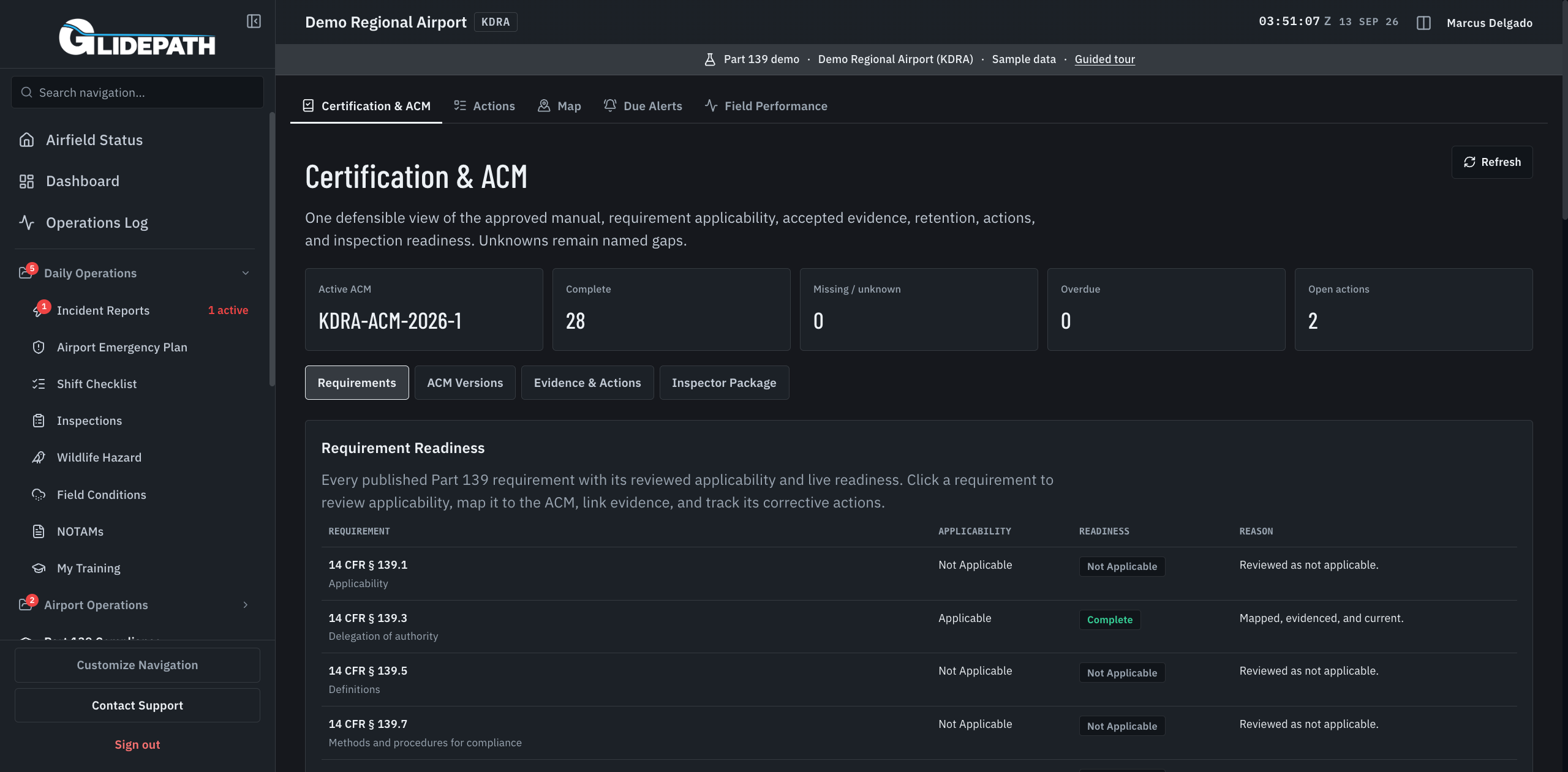
- Certification and the ACM. The Certification & ACM workspace maps each Part 139 requirement to your approved ACM, its evidence, and its corrective actions, so gaps stay visible.
- Self-inspections. Part 139 self-inspection software covers daylight and nighttime inspections, continuous surveillance, special inspections, and findings that become work orders.
- Training. Part 139 training records keep learner records, courses, sessions, and qualifications tied to your airport’s program.
- ARFF and the emergency plan. ARFF compliance tracks the approved Index basis, response fleet, agents, staffing, and response checks. The airport emergency plan workspace keeps annual reviews, exercises, and after-action records.
- Records. The airport records export builds a package for any period you choose.
Want to see it? Request a demo and we’ll walk through the certification modules on demo data, or start with Glidepath for civilian airports.
Sources
- 14 CFR §139.1, Applicability; §139.5, Definitions
- 14 CFR §139.103, Application for certificate; §139.107, Issuance of certificate; §139.111, Exemptions
- 14 CFR §139.201, General requirements; §139.203, Contents of Airport Certification Manual; §139.205, Amendment of Airport Certification Manual
- 14 CFR §139.301, Records; §139.315, Aircraft rescue and firefighting: Index determination; §139.319, Aircraft rescue and firefighting: Operational requirements
- 14 CFR §139.401, General requirements (Airport Safety Management System); §139.403, Airport Safety Management System implementation
- FAA, Part 139 Airport Certification; FAA, What is Part 139?
- FAA news release, FAA Grants Commercial Operating Certificate to Washington Manassas Airport (August 31, 2026)
- FAA news release, FAA Grants Commercial Operating Certificate to McKinney National Airport (September 24, 2026)
- Community Impact, Avelo Airlines launches 1st flight out of McKinney National Airport (November 11, 2026)
- Related Glidepath guides: How to Prepare for an FAA Part 139 Certification Inspection; Part 139 Self-Inspection Checklist
Regulation text current per eCFR as of November 19, 2026. FAA pages and news releases checked November 22, 2026.
See the certification modules on demo data.
Request a demo of Glidepath for an airport working toward, or new to, a Part 139 certificate.