
Airfield Operations
Airfield Driving: How Part 139 Airports and Military Airfields Train, Test, and Authorize Drivers
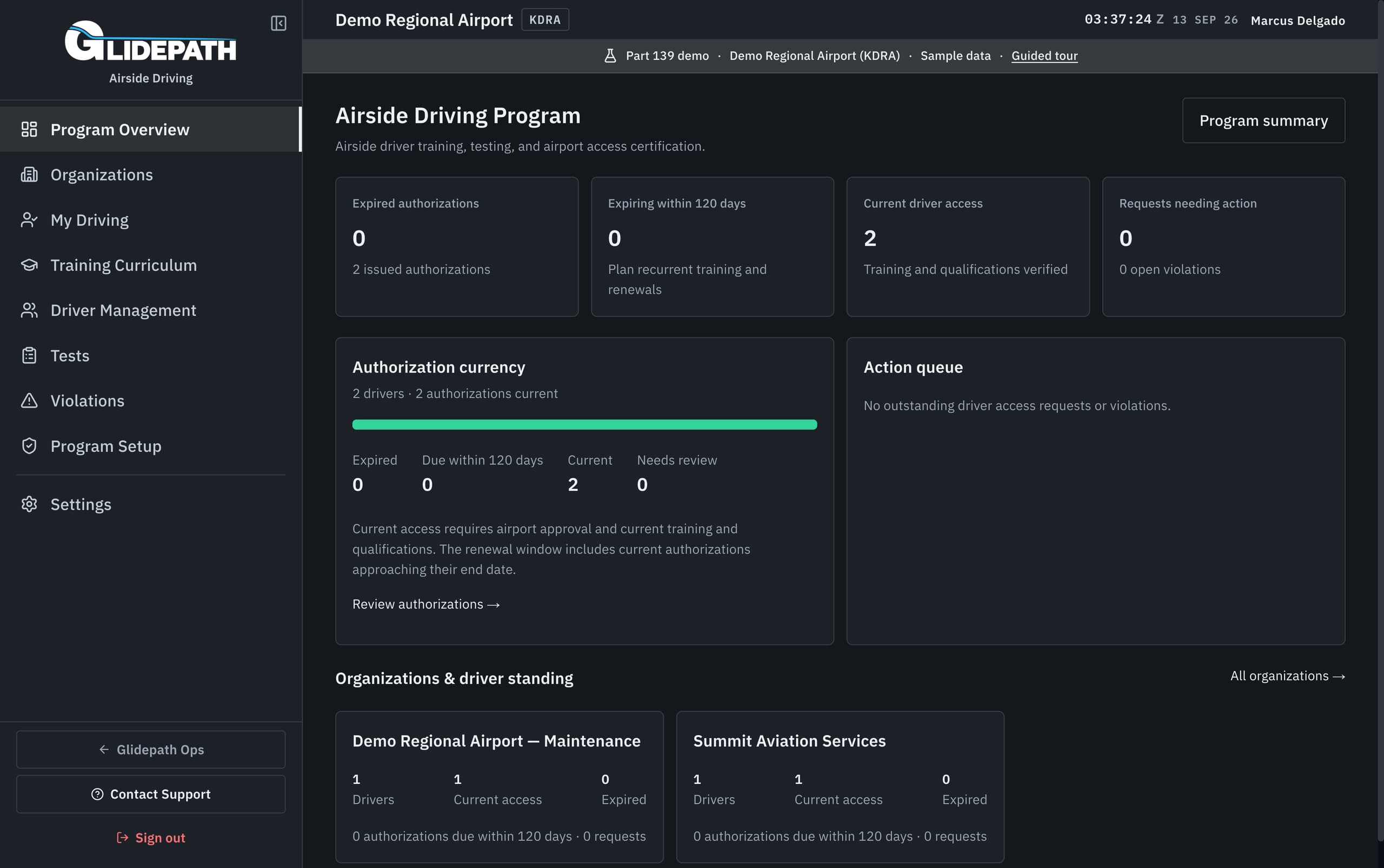
Airfield driving programs decide who may drive on an airfield and prove they were trained. Part 139 airports follow 14 CFR 139.329 and 139.303: limit access, train drivers before duty and at least every 12 calendar months, control traffic by radio or escort, and keep records. DAFI 13-213 covers the same ground for Department of the Air Force airfields.
It’s the same safety job on any airfield. The rulebook, the program owner, and some of the words change. This guide is for operations and training staff at Part 139 airports and military airfield management teams. Each statement is labeled Rule (14 CFR Part 139), AC (FAA guidance), DAFI (DAFI 13-213 as amended), or Practice (our advice). It doesn’t cover other services’ guidance.
What counts as airfield driving, and why are there two rulebooks?
Airfield driving is operating a vehicle on the airside, from runways to aprons. A driving program controls who may drive there, where, and how.
Part 139 covers airports with scheduled air carrier passenger service in aircraft configured for more than 9 seats, or unscheduled service in aircraft with at least 31 seats (§139.1(a)). It excludes “Airports operated by the United States” (§139.1(c)(2)), so military airfields run under their own instructions (Rule).
DAFI 13-213, Airfield Driving, is the Department of the Air Force instruction. Headquarters sets the standard and installations write supplements. It covers Air Force and Space Force organizations, including Guard, Reserve, and contracted locations (DAFI).
What about joint-use and shared-use airfields?
§139.5 defines a joint-use airport as one “owned by the Department of Defense, at which both military and civilian aircraft make shared use of the airfield.” A shared-use airport is government-owned, co-located with an air carrier airport, and shares parts of the airfield. Part 139 applies to the portions within the authority of the person serving passenger operations (§139.1(b)) (Rule). DAFI 13-213 ¶1.1.4 says airfield management at shared-use airfields “should work with the civil airport manager” (DAFI). The letter of agreement and the Airport Certification Manual (ACM) or supplement decide who trains and who authorizes (Practice).
What does 14 CFR 139.329 require at a Part 139 airport?
Everything in this table is Rule, paraphrased from 14 CFR 139.329, Pedestrians and ground vehicles.
| Rule | What it requires (paraphrase) |
|---|---|
| §139.329(a) | Limit access to movement and safety areas to the pedestrians and vehicles airport operations need |
| §139.329(b) | Set procedures for safe, orderly access and operation, including consequences of noncompliance for all persons |
| §139.329(c) | With the tower open, control every pedestrian and vehicle by tower radio or an escort with radio; where radio isn’t practical, by FAA-authorized signs, signals, or guards |
| §139.329(d) | With no tower, or the tower closed, use two-way radio or prearranged signs or signals |
| §139.329(e) | Train all persons on the (b) procedures before duty and at least once every 12 consecutive calendar months |
| §139.329(f) | Keep each person’s training records and records of movement and safety area accidents or incidents |
§139.303(c) sets the same 12-month cycle for “all persons who access movement areas and safety areas” and a minimum curriculum for initial and recurrent training (Rule):
- “Airport familiarization, including airport marking, lighting, and signs system.”
- “Procedures for access to, and operation in, movement areas and safety areas, as specified under § 139.329.”
- “Airport communications, including radio communication between the air traffic control tower and personnel, use of the common traffic advisory frequency …, and procedures for reporting unsafe airport conditions.”
- “Duties required under the Airport Certification Manual and the requirements of this part.”
- Any additional subjects other operating sections require.
The §139.203(b) table lists “Procedures for controlling pedestrians and ground vehicles in movement areas and safety areas” (item 22) as an ACM element for all four certificate classes, so the details are airport-specific (Rule). Read your ACM section first (Practice).
Is AC 150/5210-20A mandatory?
Not in itself. AC 150/5210-20A, Ground Vehicle Operations (September 1, 2015) says that in general “use of this advisory circular is not mandatory,” but adherence “may materially assist the airport operator in complying” (AC ¶2). Part 139 is the rule. The AC, with its sample curriculum, training manual, and letter of agreement, explains one acceptable way to meet it.
What does DAFI 13-213 require at a military airfield?
The public DAFI 13-213 carries the base instruction (4 February 2020, Change 1 of 24 March 2022) and a mandatory guidance memorandum dated 30 September 2026 that prevails where the two conflict. Memo paragraph numbers don’t match the base, so they’re cited as “memo.” All of this is DAFI.
Who owns it. Airfield management runs the installation program, the host commander appoints its program manager, and higher headquarters monitors compliance (memo ¶2.2.4, 2.3.6, 2.11.1).
Who may drive. A driver holds a valid airfield driving license (the DAFI calls it a certificate of competency), carried as a physical copy, or is escorted by someone who does. Access is either controlled movement area (CMA), where tower approval is needed to enter, or non-CMA, “ramp only.” Visitors and non-base contractors get restricted, time-limited licenses (memo ¶2.10.1, 4.28.2.1.2).
Training and testing. Before a license is issued (memo ¶3.3–3.5):
- A one-time computer-based course, classroom training as the local supplement sets, and practical day and night familiarization, with the Air Force’s electronic training, testing, and certification system the primary means (memo ¶3.1, 3.3).
- Closed-book tests on the airfield diagram, communications (CMA drivers), general knowledge, and runway incursion prevention, with 100% required on the diagram, communications, and incursion tests, plus a check-ride where the person drives (memo ¶3.4).
- A color vision test for CMA access; failing it means a ramp-only license (memo ¶3.5).
- Retest waits of 24, 48, and 72 hours after the first, second, and third failures (memo ¶3.4.2).
Refresher and lapse. Refresher training, with the incursion prevention test, is due every 12 months (memo ¶3.3.2). If a driver doesn’t pass the refresher test within 12 months, the license is suspended. At 15 months it expires, and all training and testing repeat (memo ¶2.10.9–2.10.10). Unit managers check expiration dates at least monthly (memo ¶2.8.15).
Spot checks. Airfield management makes random spot checks that at a minimum cover the airfield diagram, visual aids, and the driver’s license (memo ¶2.11.2). Results go to the quarterly airfield operations board (memo ¶2.7.26).
Consequences. Airfield management can suspend or revoke privileges regardless of unit, and offense ladders escalate with repeat violations (memo ¶4.30). Violations go into the electronic system’s tracker within 72 hours (memo ¶4.30.1.5 and its system-usage attachment). After a controlled movement area violation, commanders are notified within 3 duty days and the unit’s program is reviewed (memo ¶4.32.2, 4.32.4). Reinstatement means redoing training and testing (base ¶4.31.1).
The 30 September 2026 memorandum is time-limited and will be replaced by an interim change or a rewrite. Check the current version on e-Publishing, and your installation’s supplement, before you rely on any detail here.
Same job, different rulebook: how do the two compare?
The middle column is Rule unless it says AC. The right column is DAFI, with memo paragraphs.
| Topic | Part 139 airport (Rule/AC) | Military airfield (DAFI) |
|---|---|---|
| Governing document | 14 CFR Part 139; FAA ACs are guidance | DAFI 13-213, with installation supplements |
| Program owner | The certificate holder, through its ACM (§139.203(b) item 22) | Airfield management; the host commander appoints the installation manager |
| Authorization | Procedures in the ACM; the AC suggests badging and training levels by driving area (AC ¶2.2.1, ¶6.2) | A physical license in hand, or an escort who holds one; CMA or ramp-only access |
| Initial training | Before first performing duties; minimum curriculum in §139.303(c) | Computer-based course and practical familiarization before the license is issued |
| Recurrent training | At least every 12 consecutive calendar months (§139.329(e); §139.303(c)) | Annual refresher including the runway incursion prevention test (memo ¶3.3.2) |
| Lapse and tracking | Stay inside the 12-month cycle; the rule has no suspension or expiry steps | Suspended at 12 months without the refresher test, expired at 15 (memo ¶2.10.9–2.10.10) |
| Testing | The operator “can test” (AC ¶2.2.5); the rule sets no format or pass mark | Closed-book tests and a check-ride; 24-, 48-, and 72-hour retest waits (memo ¶3.4) |
| Spot checks and audits | Not required by §139.329; CertAlert 22-07 recommends spot checks (AC) | Random spot checks; annual unit program inspection (memo ¶2.11.2, 2.7.22) |
| Radio and escorts | Tower radio, an escort with radio, or an authorized alternative (§139.329(c)–(d)) | Tower approval for every CMA entry, read-back, certified escorts (base ¶4.2, 4.23) |
| Consequences | Procedures state consequences for all persons (§139.329(b)); remedial training goes with enforcement (AC ¶2.2.2.3) | Offense ladders, suspension and revocation, retraining before reinstatement (memo ¶4.30) |
| Records | Training 24 months; incidents 12 months (§139.329(f); §139.301(b)) | Follows the Air Force records schedule; no retention period stated |
Same questions under both: who is allowed, were they trained and tested, who checked, and can you show the record?
What stays the same on every airfield?
Every driver is trained before driving and again on a recurring cycle (§139.329(e); memo ¶3.3.2) (Rule; DAFI). Only authorized, trained drivers, or people escorted by one, go where the rules control traffic (§139.329(a), (c)) (Rule). The FAA recommends supervised practical exams (AC ¶2.2.3) and says the operator “can test” trainees (AC ¶2.2.5) (AC); DAFI 13-213 requires tests and a check-ride (memo ¶3.4) (DAFI).
Spot checks and audits
CertAlert 22-07 asks Part 139 operators to consider random spot checks and procedures that keep non-proficient drivers out of the movement area (AC). DAFI 13-213 requires random spot checks and an annual unit program inspection (memo ¶2.11.2, 2.7.22) (DAFI). For the daily inspection that goes with them, see the Part 139 self-inspection checklist.
Three habits that work under either rulebook (Practice):
- Tie the curriculum and tests to your airfield diagram and the hot spots drivers actually cross.
- Show each driver’s authorization status where a spot checker can see it in seconds.
- Use a short spot-check form (date, location, driver, what was checked, outcome) that someone else could repeat.
Movement area, safety area, non-movement area: where do the radio and escort rules start?
The two rulebooks draw the same line with different words.
| Part 139 term (Rule) | DAFI term (DAFI) | Plain meaning |
|---|---|---|
| Movement area: the runways, taxiways, and other areas used for taxiing, takeoff, and landing, excluding loading ramps and aircraft parking areas (§139.5) | Controlled movement area (CMA), used in place of movement area; tower approval is needed to enter (memo glossary) | Where the tower controls every vehicle move |
| Non-movement area: ramps, aprons, and on-airport fuel farms used for loading, unloading, parking, and moving aircraft (§139.5) | Non-CMA, or “ramp” | Drivers still need training and authorization, but the tower doesn’t clear each move |
| Vehicle/pedestrian deviation (FAA): “Pedestrians or vehicles entering any portion of the airport movement areas (runways/taxiways) without authorization from air traffic control” | Vehicle/pedestrian deviation and controlled movement area violation (CMAV): entering the CMA without specific tower approval, including runway incursions and communication errors (memo glossary) | A driver breaks the control rule, with or without an aircraft nearby |
§139.329 pairs safety areas, the prepared surfaces around each runway and taxiway (§139.5), with movement areas in every control requirement (Rule). Each vehicle uses its own tower radio or follows an escort who has one (§139.329(c)) (Rule). DAFI 13-213 adds read-back of every instruction and no blanket runway approvals; escorts relay tower instructions and must be trained, certified, and, for the CMA, CMA qualified (base ¶4.2, 4.23.1; memo ¶4.23.2) (DAFI).
Vehicle marking and lighting guidance is in AC 150/5210-5D, mandatory only for vehicles bought with federal grant or Passenger Facility Charge money (AC ¶3).
How does a driving program prevent runway incursions?
The FAA defines a runway incursion as “any occurrence at an airport involving the incorrect presence of an aircraft, vehicle or person on the protected area of a surface designated for the landing and take off of aircraft” (FAA Runway Incursions). A vehicle/pedestrian deviation is one of its three sources, defined in the table above.
Section 139.329 never uses the words “runway incursion.” The duty is training and control procedures. Preventing incursions is what they’re for (Rule).
What to teach (AC): CertAlert 22-07 asks operators to consider training drivers to keep scanning outside the vehicle even with a clearance, to ask for clarification when a transmission isn’t clear, and to follow local rules against phone use in movement areas. The FAA airfield drivers page has more.
After an event (AC): remedial training goes with enforcement (AC ¶2.2.2.3), but the sample manual says it “is not considered acceptable consequences of noncompliance” on its own.
On a military airfield (DAFI): for an actual or suspected runway incursion, the license is surrendered and privileges are suspended until investigation and retraining (base ¶4.32.1). Three vehicle or pedestrian runway incursions, CMA violations, or a mix within six months call for a working group within 30 days (memo ¶2.4.2). After any near miss, retrain, record it, and check whether the same spot keeps coming up (Practice).
What records should a driving program keep, and for how long?
| Record | Part 139 airport (Rule) | Military airfield (DAFI) |
|---|---|---|
| Driver training | Description and date. 24 months after access ends (§139.329(f)(1)); 24 calendar months after training (§139.303(d)); 24 calendar months, start unstated (§139.301(b)(6)) | Kept by the unit program manager or in the electronic system; no period stated (base ¶2.8.12; memo ¶3.1) |
| Accidents and incidents | Description and date of events involving air carrier aircraft, a ground vehicle, or a pedestrian; 12 calendar months from the event (§139.329(f)(2); §139.301(b)(7)) | Violations in the tracker within 72 hours; incursion reports and working-group minutes in the program binder (memo ¶4.30.1.5, 2.7.12) |
| Spot checks | Not a Part 139 record. Keep them with training records (Practice) | Logged, with results to the airfield operations board (memo ¶2.11.2, 2.7.26) |
| Driver roster | Not specified. Keep a current list with access level and next due date (Practice) | Driver list with restrictions and due dates (base ¶2.7.18); downloaded quarterly (memo ¶2.7.32) |
The sources disagree: §139.329(f)(1) and AC ¶2.2.1 count 24 months from the end of access, §139.303(d) from completion of training, and §139.301(b)(6) doesn’t say. Follow the longer reading and confirm with your FAA Airport Certification Safety Inspector (Practice).
Frequently asked questions
Do military airfields have to follow Part 139?
No. §139.1(c)(2) excludes airports operated by the United States, so Air Force and Space Force airfields follow DAFI 13-213 and their supplements. At joint-use and shared-use airfields, Part 139 covers the civil portions (§139.1(b)).
How often do airport drivers need training under Part 139?
Before first performing duties in movement or safety areas, and at least once every 12 consecutive calendar months (§139.329(e); §139.303(c)). The FAA’s example: training on July 1, 2014 stays valid through July 31, 2015 (AC 150/5210-20A ¶2.2.2.2).
Is AC 150/5210-20A mandatory?
Not in itself. The AC says that in general its use is not mandatory, but adherence may materially assist compliance with the mandatory §139.329 and §139.303.
What is the difference between the movement area and a controlled movement area?
Movement area is the Part 139 term (§139.5). DAFI 13-213 says controlled movement area, where tower approval is needed to enter. Same idea, different wording. Your airfield diagram shows the boundary.
What goes in a driver spot check?
Part 139 doesn’t require spot checks, but CertAlert 22-07 recommends them. DAFI 13-213 requires random checks covering at least the airfield diagram, the driver’s license, and visual aids (memo ¶2.11.2). Write each check down so someone else can repeat it.
How long do I keep driver training records?
Under Part 139, 24 months (§139.329(f)(1); §139.301(b)(6); §139.303(d)). The sections count it differently, so use the longer reading. DAFI 13-213 states no period and refers to the Air Force records schedule. Follow your ACM or installation records plan.
How Glidepath supports an airfield driving program
Glidepath’s team has 19 years in airfield operations across multiple military airfields. The civilian and military driving programs are separate modules because they follow different rulebooks. Glidepath supports your program. It doesn’t issue licenses or approve access for you.
- Part 139 airports. The airside driving program workspace keeps people, training, access authorizations, optional vehicle permits, incidents, and violations together. Training and authorization are distinct records, and the airport makes the decision.
- Military airfields. The DAFI 13-213 airfield driving program software covers units and appointments, a curriculum filled in with your airfield’s facts, proctored tests with server-side grading and a database-enforced failure ladder, and a license register with refresher tracking. Trainees are records, not app users.
- Spot checks. Structured airfield driving spot checks compute their outcome and roll up into a PDF report for the airfield operations board.
- Records. The airport records export and airfield records export build a package for any period you choose.
Want to see it? Request a demo and we’ll walk through a driving program on demo data, or start with Glidepath for military airfields.
Sources
- 14 CFR §139.329, Pedestrians and ground vehicles (eCFR)
- 14 CFR §139.303, Personnel; §139.301, Records; §139.203, Contents of the Airport Certification Manual
- 14 CFR §139.1, Applicability; §139.5, Definitions
- FAA AC 150/5210-20A, Ground Vehicle Operations to include Taxiing or Towing an Aircraft on Airports (AC page)
- FAA AC 150/5210-5D, Painting, Marking, and Lighting of Vehicles Used on an Airport
- FAA Part 139 CertAlert 22-07, Movement Area Training and Situational Awareness (November 29, 2022)
- FAA, Runway Incursions; FAA, Airfield Drivers
- DAFI 13-213, Airfield Driving, with Guidance Memorandum DAFI13-213_DAFGM2026-01 (30 September 2026) (Department of the Air Force e-Publishing)
- Related Glidepath guides: Part 139 Self-Inspection Checklist; Runway Condition Reporting: How FICON NOTAMs and the RCAM Work
Regulation text current per eCFR as of October 15, 2026. FAA sources and DAFI 13-213, as amended by the 30 September 2026 guidance memorandum, checked October 17, 2026.
See an airfield driving program on demo data.
Request a demo of Glidepath for your Part 139 airport or military airfield.