
Part 139 Compliance
Part 139 Self-Inspection Checklist: What 14 CFR 139.327 Requires and What to Check
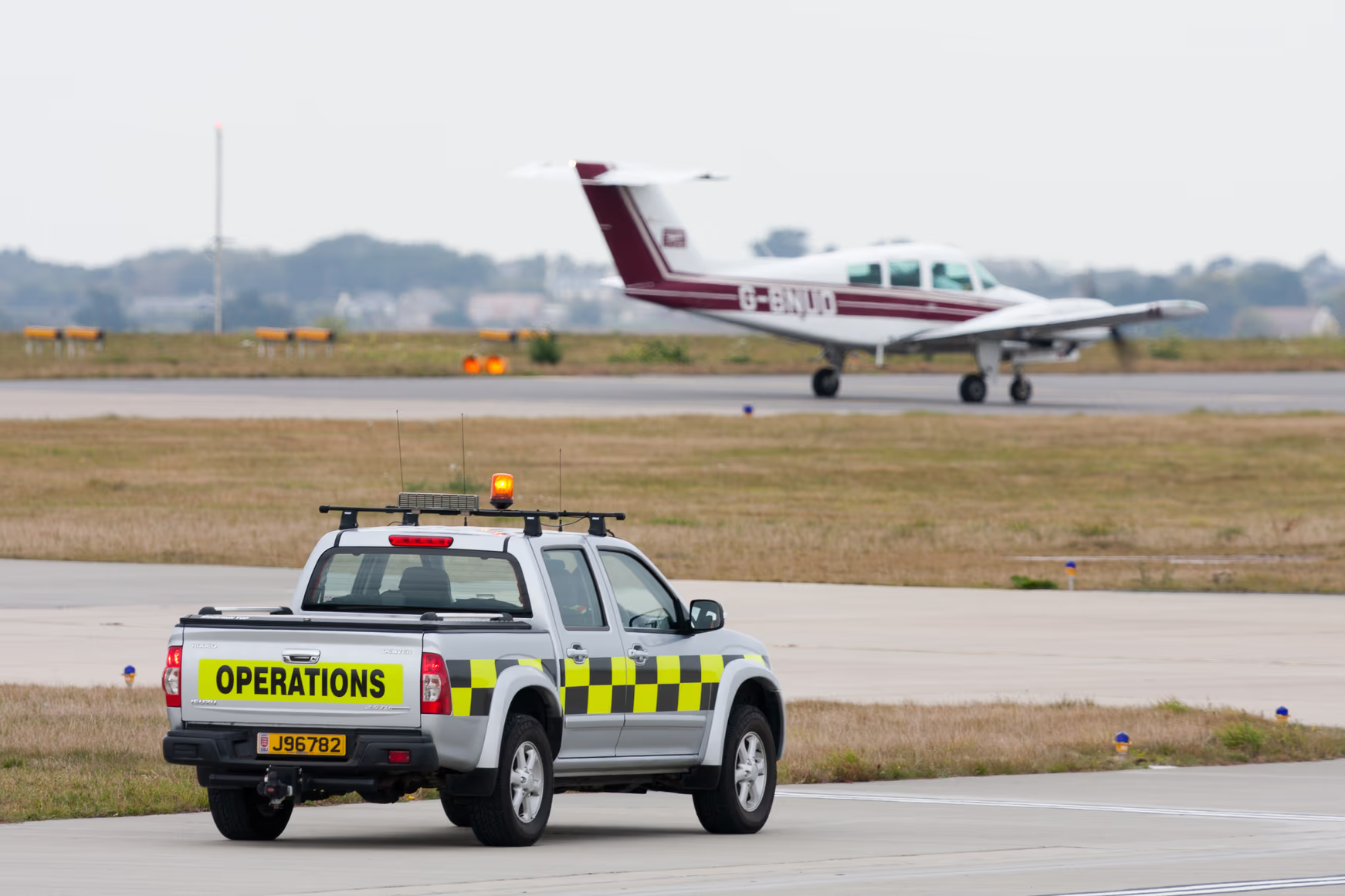

Under 14 CFR 139.327, certificated airports self-inspect daily (unless the ACM says otherwise), when unusual conditions (construction, weather) require it, and right after an accident or incident. AC 150/5200-18D’s Part 139 self-inspection checklist covers pavement, safety areas, markings, signs, lighting, NAVAIDs, obstructions, fueling, snow/ice, ARFF, public protection, wildlife, and construction. Records show conditions found and corrective actions, kept 12 months.
This checklist is for operations staff, certification leads, and new inspectors. General aviation airports that follow the FAA’s advisory circular as voluntary guidance can use it too.
The first drive of the day is the airport checking its own field. The hard part is what happens to the X’s afterward: who hears about the unlit sign, who fixes it, and who goes back out after dark to see it lit. Each item below is labeled Rule (14 CFR Part 139), AC (FAA guidance), or Practice (our own advice).
What does 14 CFR 139.327 require?
Everything in this table is Rule, quoted or closely paraphrased from §139.327.
| Requirement | What the rule says | Cite |
|---|---|---|
| When to inspect | “Daily, except as otherwise required by the Airport Certification Manual”; “When required by any unusual condition, such as construction activities or meteorological conditions, that may affect safe air carrier operations”; and “Immediately after an accident or incident” | §139.327(a)(1)–(3) |
| Equipment | “Equipment for use in conducting safety inspections of the airport” | §139.327(b)(1) |
| Communication | Procedures, facilities, and equipment for “reliable and rapid dissemination of information” between airport personnel and air carriers | §139.327(b)(2) |
| Qualified, trained inspectors | Trained under §139.303, with initial and recurrent instruction every 12 consecutive calendar months in airport familiarization, the emergency plan, NOTAM procedures, pedestrian and ground vehicle procedures, and discrepancy reporting | §139.327(b)(3) |
| Getting things fixed | “A reporting system to ensure prompt correction of unsafe airport conditions noted during the inspection, including wildlife strikes” | §139.327(b)(4) |
| Inspection record | Keep, “for at least 12 consecutive calendar months,” a record of each inspection “showing the conditions found and all corrective actions taken” | §139.327(c)(1) |
| Training record | Description and date of training, kept 24 consecutive calendar months after completion | §139.327(c)(2) |
| How-to guidance | “FAA Advisory Circulars contain methods and procedures for the conduct of airport self-inspections that are acceptable to the Administrator” | §139.327(d) |
The daily self-inspection isn’t the FAA’s annual certification inspection, where an FAA inspector reviews the certificate holder. To rehearse for that one, run an annual certification-readiness self-audit.
Who has to follow §139.327?
Every certificate holder, in every class (Rule). The ACM element table in §139.203(b) lists self-inspection procedures (item 21) for Classes I through IV. That’s where your ACM’s self-inspection procedures are written down. The same table doesn’t list snow and ice, NAVAID protection, public protection, wildlife, or construction areas as required ACM elements for Class IV airports.
Part 139 doesn’t apply to “Airports operated by the United States” (§139.1(c)(2)); military airfields follow their own service guidance. General aviation airports without a certificate can use the AC’s checklist as a model.
Rule, FAA guidance, or good practice?
Rule is the text of 14 CFR Part 139. AC is FAA AC 150/5200-18D, Airport Safety Self-Inspection (September 27, 2022, with 2023 errata). It’s the guidance §139.327(d) points to: one acceptable way to comply, not the regulation. It cancelled AC 150/5200-18C (2004), which still turns up in search. Practice is our own advice. If your approved ACM and this guide differ, follow the ACM and check with your FAA Airport Certification Safety Inspector.
The four types of Part 139 self-inspection
AC 150/5200-18D describes four types of self-inspection. The rule names the daily and event-driven inspections; the AC fills in the rest.
| Type | When | Source |
|---|---|---|
| Daily: daylight and nighttime | Daily unless the ACM says otherwise. “Larger airports normally conduct multiple inspections daily,” and an effective program has “a daylight inspection and a separate nighttime inspection.” | Rule §139.327(a)(1); AC §4.1.1 |
| Continuous surveillance | Whenever personnel are in areas the ACM designates: fueling, construction, ground vehicles, wildlife, FOD | AC §4.1.2, §7.2 |
| Periodic condition | Scheduled checks of slow-changing conditions, “usually … weekly or quarterly”: marking condition, rubber and friction, pavement lips, drainage | AC §4.1.4, §7.3 |
| Special | After a complaint, an unusual condition such as significant weather, or an accident or incident; and at the end of each construction shift, day, and project | Rule §139.327(a)(2)–(3); AC §4.1.3, §7.7 |
“Daily” means at least daily, and not the same route every time
Vary the pattern so the drive doesn’t become routine (AC §3.2). Inspect runways in both directions, including stub taxiways up to the hold position, which the AC calls “often overlooked” (AC §3.2.1). Tenants can inspect leased areas by agreement, but the certificate holder stays “ultimately responsible” (AC §3.3).
At night, the rule and the AC don’t say the same thing. The rule defers to the ACM. AC §4.1.1 says Class I–IV airports “must conduct a daily airport inspection, to include a nighttime inspection,” with or without air carrier service, unless the ACM says otherwise. The AC’s “must” applies to airports with federal grant or PFC obligations and to those using its method to show compliance (AC ¶3). Your approved ACM sets the schedule. Confirm it with your FAA inspector.
What does a Part 139 self-inspection include? The checklist, area by area
Here’s the daily checklist in the order of AC 150/5200-18D Appendix B (pages B-3 to B-5), plus a line for emergency access. The AC’s form marks ✓ or X in day and night columns, with remarks and a resolved-by column (App. B ¶B.3). The FAA also publishes a one-page print version. The Rule column is 14 CFR Part 139; the check column is AC guidance. The item-by-item lists are in the printable checklist.
| Area | Rule | What to check (AC) |
|---|---|---|
| 1. Paved and unpaved areas | §139.305(a): no lips over 3 inches; no holes over 3 inches deep (or with 45-degree sides) unless a 5-inch circle covers them; no ponding. §139.307 for unpaved areas | Cracks, spalling, heaves, FOD, rubber, edge dams; unpaved slopes steeper than 2:1 (§7.1.1–7.1.2) |
| 2. Safety areas | §139.309(b): graded, drained, able to support ARFF and snow equipment; only objects needed there, frangible no more than 3 inches above grade | Ruts, erosion, bases and covers at grade, unauthorized objects, construction material (§7.1.3) |
| 3. Markings | §139.311(a): runway, taxiway, holding position, and ILS critical area markings | Layout, color, fading, rubber; glass beads (§7.1.4) |
| 4. Signs | §139.311(b): route, holding position, and ILS critical area signs, lighted as required | Match the Sign Plan; obscured, damaged, faded, or unlit; frangible mounts (§7.1.5) |
| 5. Lighting | §139.311(c): runway, taxiway, approach, beacon, and obstruction lighting | Out, dim, missing, or misaimed fixtures; runway guard lights; pilot-controlled lighting (§7.1.6) |
| 6. Snow and ice (seasonal) | §139.313 applies, as determined by the Administrator, where snow and icing conditions occur | Snowbank clearance; lights, signs, and NAVAID areas clear; ARFF routes; RCAM reporting (§7.1.7) |
| 7. ARFF | §§139.315–139.319: index, equipment, operations | Equipment, agent, and crew to meet the index; alarms; response routes (§7.1.8) |
| 8. Fueling | §139.321: fuel fire safety standards; tenant facilities inspected at least once every 3 consecutive months | Fencing, signs, shut-off placards, extinguishers, leaks, hoses, mobile fuelers (§7.1.9) |
| 9. Obstructions | §139.331: removed, marked, or lighted unless an FAA aeronautical study finds otherwise | Obstruction lights; cranes on and off the airport; trees (§7.1.12) |
| 10. Beacon, wind indicators, and NAVAIDs | §139.311(c) beacon; §139.323 wind cones; §139.333 NAVAID protection | Beacon color; wind cones swing freely; PAPI or VASI aligned; critical areas clear (§7.1.10, §7.1.13) |
| 11. Public protection | §139.335: safeguards against inadvertent entry; jet blast protection | Fences, gates, locks, signs; unauthorized people or vehicles (§7.1.14) |
| 12. Wildlife | §139.337(a): immediate action on wildlife hazards | Wildlife and location on the diagram; carcasses, nests, attractants; fence gaps (§7.1.15) |
| 13. Construction and unserviceable areas | §139.341: construction areas, equipment, and roads marked, and lighted where appropriate | Barricades and lights; equipment parked clear; stockpiles; closed surfaces; NOTAMs (§7.1.17) |
| 14. Emergency access and condition reporting | §139.325 emergency plan; §139.339 condition reporting | Mutual-aid gates and access points usable (§7.1.11); NOTAMs current |
What changes on the nighttime self-inspection?
Light inspections must happen “during periods of darkness,” when lights are “the primary visual aid for pilots” (AC §7.1.6.3). Add these after dark:
- Lighting color, orientation, and outages, including missing, out, or dim fixtures (AC §7.1.6.2)
- Mandatory signs lit with the associated runway lighting; runway exit signs lit when runway lights are on (AC §7.1.5(8)–(10))
- Glass-bead reflectivity on markings (AC §7.1.4(9))
- The rotating beacon (AC §7.1.6.2(5)), and lighted wind cones if the airport is open for air carrier operations at night (Rule §139.323(a))
- Obstruction lights (AC §7.1.6.2(6)) and construction barricade lights (AC §7.8.1(3))
- Low-visibility (SMGCS) lighting checks, if your airport has that plan (AC §7.1.6.2)
Example: the night inspector finds a holding position sign unlit. That’s a condition to report to air carriers (Rule §139.339(c)), and the AC says the inspector makes sure a NOTAM is issued (AC §7.1.5(11)). Don’t close the work order until someone has seen the sign lit at night (Practice).
Continuous, periodic, special, and construction checklists
The AC gives each of these its own sheet (Appendix B, pages B-8 to B-12); the printable checklist includes them.
Continuous surveillance: in areas the ACM designates, watch for drivers off airport rules, unsafe fueling (no bonding, blocked deadman controls, fuelers parked too close), contractors off the safety plan, open gates, unauthorized people or animals, wildlife, and FOD (AC §7.2).
Periodic condition: scheduled checks of the conditions that change slowly.
| Area | Checks | Source |
|---|---|---|
| Pavement and markings | Rubber and friction; lips and turf damming; marking condition each spring and fall | AC §4.1.4, §7.3.1–7.3.2 |
| Lighting | Standby generator and circuit resistance tests; aiming; lenses | AC §7.3.2.2, §7.4.2.1 |
| Fueling | Tenant fuel farms and mobile fuelers, at least once every 3 consecutive months; record kept 12 months | Rule §139.321(d); AC §7.3.3–7.3.5 |
| NAVAIDs, obstructions, ARFF | Light aiming; surveyed trees and power lines; response times and drills | AC §7.4–7.6 |
Special: record the type and reason (AC App. B, page B-10). After an aircraft leaves the pavement, look for ruts from tires or recovery equipment; after heavy rain, ponding and wet markings at night; after snow removal, FOD and plow-damaged signs (AC §7.7).
Construction: inspect at the end of each shift, day, and project, before crews leave (AC §4.1.3), and print the AC’s Construction in Progress and Post Construction checklists (pages B-11 and B-12). The post-construction sheet ends with three easy-to-forget lines: update the ACM or Sign and Marking Plan, update the 5010 data, and submit any airport diagram change to the FAA’s National Flight Data Center.
What happens when an item fails? From finding to verified closure
Eight steps, each labeled Rule, AC, or Practice:
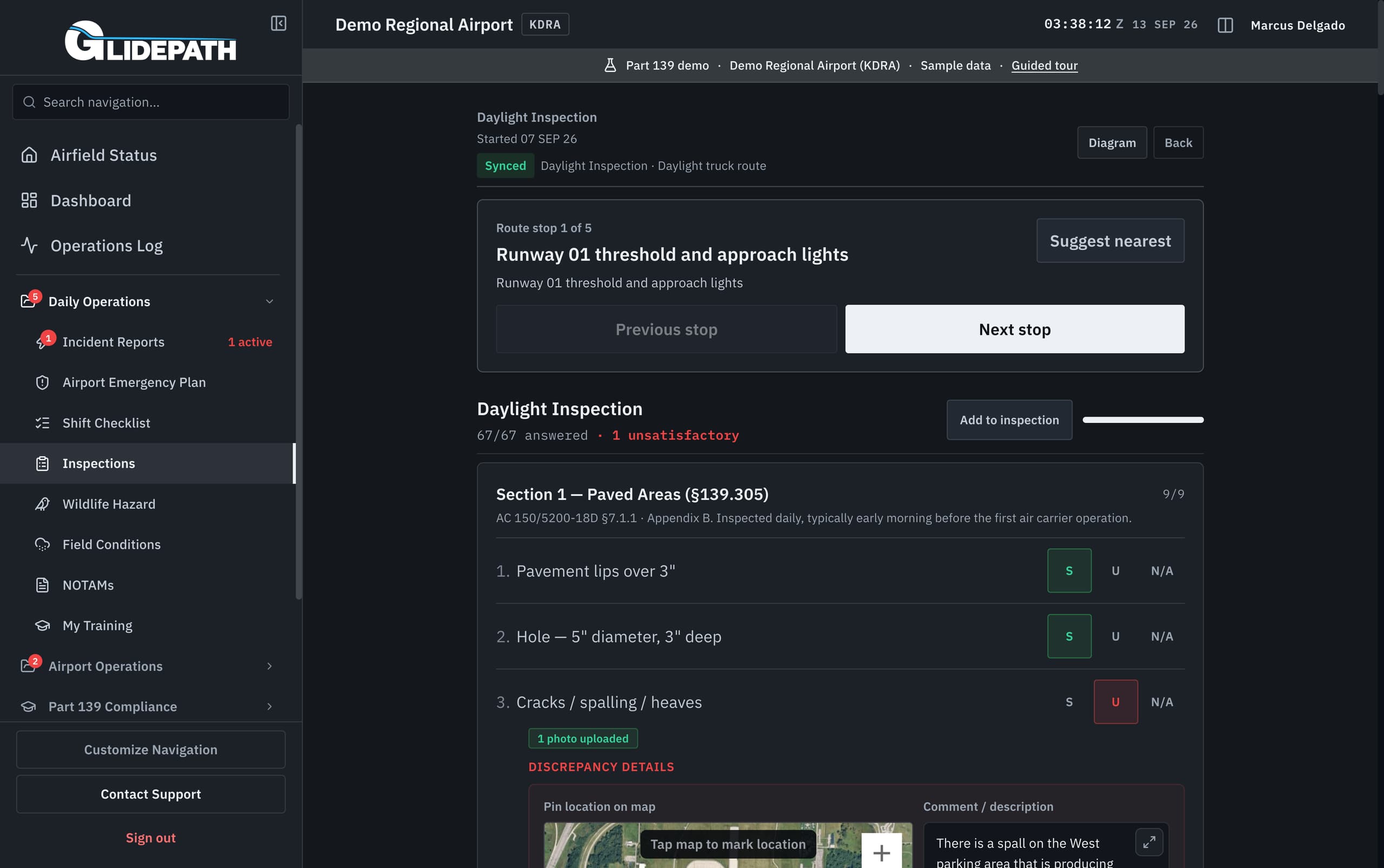
- Write it up, even if you fixed it on the spot. AC: “All conditions found must be documented on the inspection checklists, even if corrected during the inspection” (AC §6.4). Mark the spot on the diagram and add a photo where it helps (AC App. B ¶B.4; §7.1).
- Decide whether it must be reported. Rule: §139.339(c) lists the conditions to report to air carriers: construction or maintenance activity; surface irregularities; snow, ice, slush, or water; snow piled contrary to §139.313; objects contrary to §139.309; malfunctioning required lighting, holding position signs, or ILS critical area signs; unresolved wildlife hazards; unavailable ARFF; and any other condition in your ACM or that may affect safe air carrier operations. Use the NOTAM system “as appropriate” (§139.339(b)); not every discrepancy needs a NOTAM. Keep each report on record 12 months (§139.339(d)).
- Limit operations if needed. Rule: while an unsafe condition remains uncorrected, limit air carrier operations to the parts of the airport it doesn’t affect (§139.343). If a required ARFF vehicle can’t be replaced immediately, notify the FAA and air carriers, and limit operations if the index isn’t restored within 48 hours (§139.319(g)(3)).
- Act now on wildlife and fueling. Rule: §139.337(a) requires immediate action on wildlife hazards; §139.321(g) requires the airport to have tenant fueling agents correct violations immediately, and to notify the FAA Regional Airports Division Manager if a fix can’t be made in a reasonable time. AC: report strikes and carcasses on FAA Form 5200-7 (AC §7.1.15.2) and log wildlife sightings and strikes.
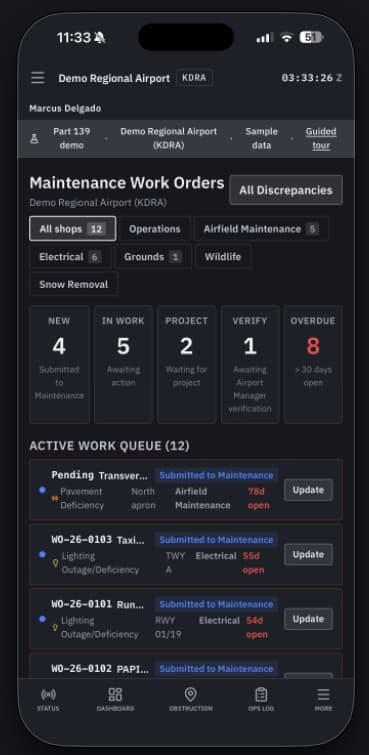
- Open a work order. Rule: “a reporting system to ensure prompt correction” (§139.327(b)(4)). AC: the airport “must include a work order system” (AC §5.1); report problems with FAA NAVAIDs or other owners’ equipment to the owner (AC §7.1.10).
- Carry it forward. AC: uncorrected deficiencies “should continue to be documented” until resolved (AC §6.4). Practice: list them at the top of the next form, with the work order number and the date first reported.
- Verify and close as a separate step. Practice: “fixed” (maintenance says it’s done) and “verified” (operations went back and looked, at night for lighting) are two entries with two names and two dates. AC: cancel the NOTAM when the condition is corrected (AC §5.2.2, §7.8.2.2).
- Record the corrective action. Rule: the record shows “the conditions found and all corrective actions taken” (§139.327(c)(1)). AC: record it on the checklist or in a work order system (AC §6.4).
How do airports track self-inspections?
On paper or electronically. The AC accepts electronic logs as long as the airport can print hard copies and make the records available to the FAA during any inspection (AC §5.2–5.2.1). Whatever the medium, the record must show the conditions found and all corrective actions taken (Rule §139.327(c)(1)), and the airport furnishes its records to the FAA on request (Rule §139.301(a)).
| Record | Keep at least | Cite |
|---|---|---|
| Self-inspection records | 12 consecutive calendar months | §139.327(c)(1); §139.301(b)(5) |
| Self-inspection personnel training | 24 consecutive calendar months after training | §139.327(c)(2); §139.301(b)(1) |
| Airport condition reports (NOTAMs and other notices to air carriers) | 12 consecutive calendar months | §139.339(d); §139.301(b)(8) |
| Tenant fueling facility inspections | 12 consecutive calendar months | §139.321(d); §139.301(b)(3) |
| Anything else your ACM specifies | As the ACM specifies | §139.301(c) |
The AC says the log helps identify trends (AC §1.1.1). In practice, look monthly for repeat findings in one spot: the same edge light, inlet, or gate.
Whatever you use, paper included, look for five things (Practice):
- Day and night halves on one record, each with its own findings
- A failed item becomes a work order with its location and photo, without retyping
- Carried-forward items visible to the next inspector
- A separate verified-closure step, with its own name and date
- A date range you can print or export as a PDF when the FAA asks
More on going digital: Can Part 139 records be kept electronically? The FAA’s certification inspection reviews airfield self-inspection forms (FAA, What is Part 139?). For that side, see our guide to preparing for an FAA Part 139 certification inspection.
Frequently asked questions
What does a Part 139 self-inspection include?
A daily inspection of the airport’s physical facilities for compliance with Part 139 Subpart D. Following FAA AC 150/5200-18D’s checklist, that covers paved and unpaved areas, safety areas, markings, signs, lighting, wind indicators and NAVAIDs, obstructions, snow and ice, ARFF, fueling, public protection, wildlife, construction areas, and condition reporting. The inspector records each condition found and the corrective action taken (14 CFR §139.327(a), (c)(1); AC 150/5200-18D Chapter 7 and Appendix B).
How often do Part 139 airports have to self-inspect?
Daily, unless the airport’s ACM says otherwise. Also when an unusual condition such as construction or weather may affect safe air carrier operations, and immediately after an accident or incident. “Daily” is a minimum: the FAA’s AC notes that larger airports normally inspect several times a day (14 CFR §139.327(a)(1)–(3); AC 150/5200-18D §4.1.1).
Is a nighttime self-inspection required?
The rule says inspect daily, except as otherwise required by your ACM. AC 150/5200-18D says certificated airports must conduct a daily inspection “to include a nighttime inspection,” because lights must be evaluated in darkness, with or without air carrier service, unless the ACM says otherwise. Follow your approved ACM and confirm the schedule with your FAA inspector (14 CFR §139.327(a)(1); AC §4.1.1, §7.1.6.3).
How long must self-inspection records be kept?
At least 12 consecutive calendar months, and the record must show the conditions found and all corrective actions taken. Training records for self-inspection personnel are kept 24 consecutive calendar months after training. Your ACM can require more (14 CFR §139.327(c)(1)–(2); §139.301(b)(1), (b)(5), (c)).
Can self-inspection records be electronic?
Yes. FAA AC 150/5200-18D says inspection logs “can be electronic but the airport operator must be able to print hard copies when necessary,” and electronic records must be available to the FAA “in an acceptable form during any inspection” (AC 150/5200-18D §5.2, §5.2.1).
Do general aviation airports have to follow §139.327?
Not unless they hold a Part 139 airport operating certificate. AC 150/5200-18D calls itself “voluntary guidance for all airport operators,” and its standards may apply through federal grant or PFC assurances. A general aviation airport can still use its checklist as a model (14 CFR §139.1; AC 150/5200-18D ¶3).
How Glidepath runs the daily self-inspection
We built Glidepath’s Part 139 self-inspection software around the same structure as this checklist. It supports your program. Your ACM still sets the scope and frequency.
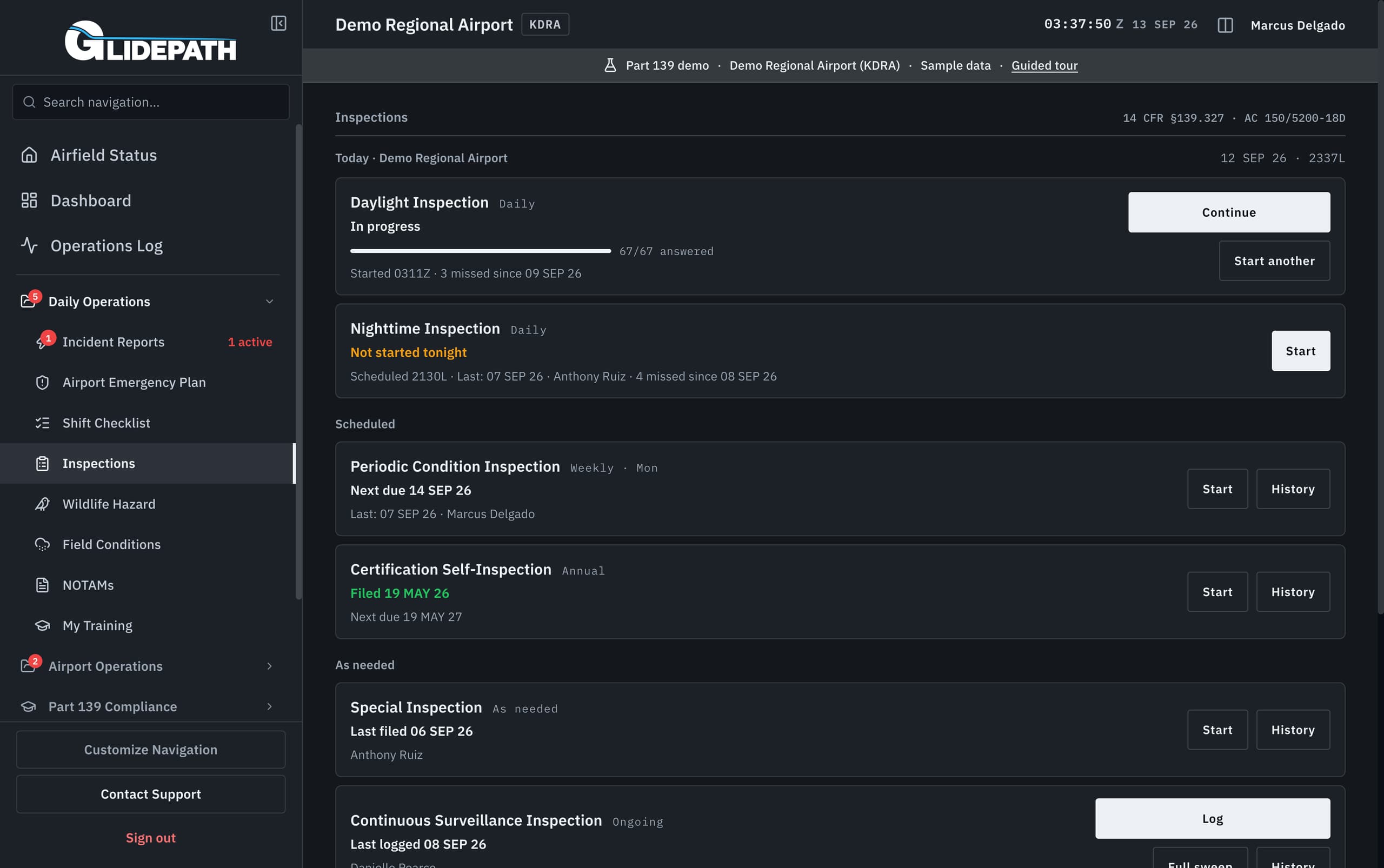
- Day and night. Daylight and nighttime halves of the daily inspection keep their own progress and findings. Continuous surveillance, periodic condition, and special inspections each have their own place, and a due-work queue shows what’s scheduled and what’s overdue.
- Findings to verified closure. A failed item can open a discrepancy that carries the note, photo, and exact spot on the map, with discrepancies tracked to verified closure: finished work sits at awaiting verification until a separate, dated sign-off.
- Lighting. With lighting outages checked against your outage standard (FAA thresholds from AC 150/5340-26C, or ICAO Annex 14), an over-threshold outage creates a discrepancy, and the alert carries the required actions and lighting NOTAM wording.
- Condition reporting. Glidepath drafts wording for field condition (FICON) reports for review. It doesn’t submit the NOTAM; the airport does, through its authorized channel.
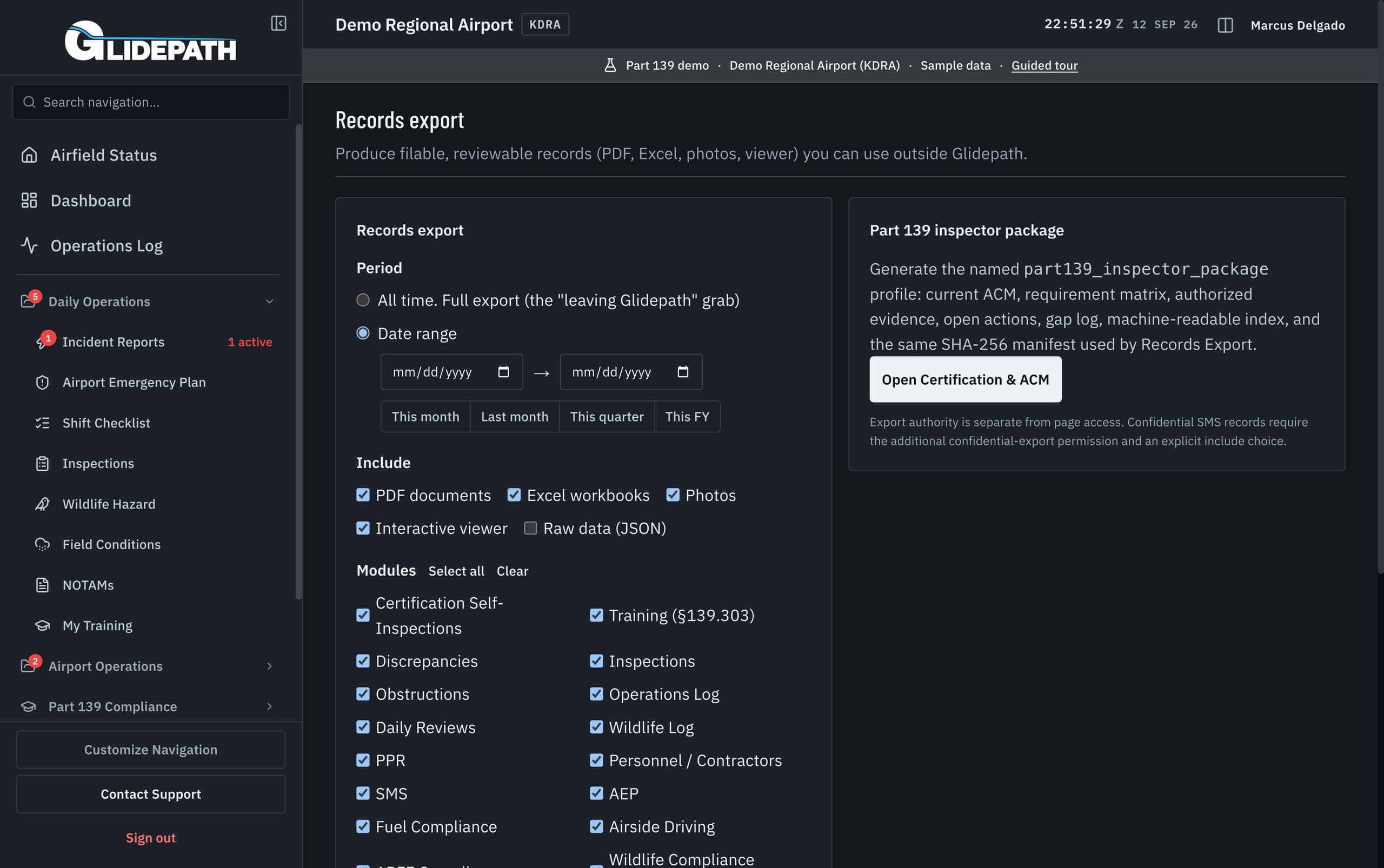
- The record. History keeps each completed inspection with its item-level findings. Export a date range as PDF or Excel, with photos, an interactive viewer, or JSON, in a ZIP with a SHA-256 manifest.
- Offline. Supported entries queue on the device and sync when the connection returns. Some actions and photo uploads need a connection, and a cached status isn’t a fresh observation.
Watch the one-minute walkthrough, Airfield Inspection App: Part 139 Self-Inspection, on YouTube. Then request a demo, and we’ll build the walkthrough around your airport.
Sources
- 14 CFR §139.327, Self-inspection program (eCFR)
- 14 CFR §139.301, Records; §139.339, Airport condition reporting; §139.343, Noncomplying conditions
- 14 CFR §139.311, Marking, signs, and lighting; §139.319, ARFF operational requirements; §139.321, Hazardous substances and fueling; §139.323, Traffic and wind direction indicators; §139.337, Wildlife hazard management
- 14 CFR §139.203, Contents of the Airport Certification Manual; §139.1, Applicability
- FAA AC 150/5200-18D, Airport Safety Self-Inspection (AC page, one-page checklist, errata)
- FAA, What is Part 139?
- Related Glidepath guides: How to Prepare for an FAA Part 139 Certification Inspection; How to Replace Paper Logs and Spreadsheets in Airport Operations
Regulation text current per eCFR as of October 1, 2026.
Run your next inspection on your own field.
See the daily self-inspection, from the first item to verified closure, set up around your airport.