
Military Airfields / Airfield Driving Program
Airfield Driving Program (DAFI 13-213)
The airfield driving program end to end: units, training, proctored testing, AF Form 483 issuance, refreshers, and violations.
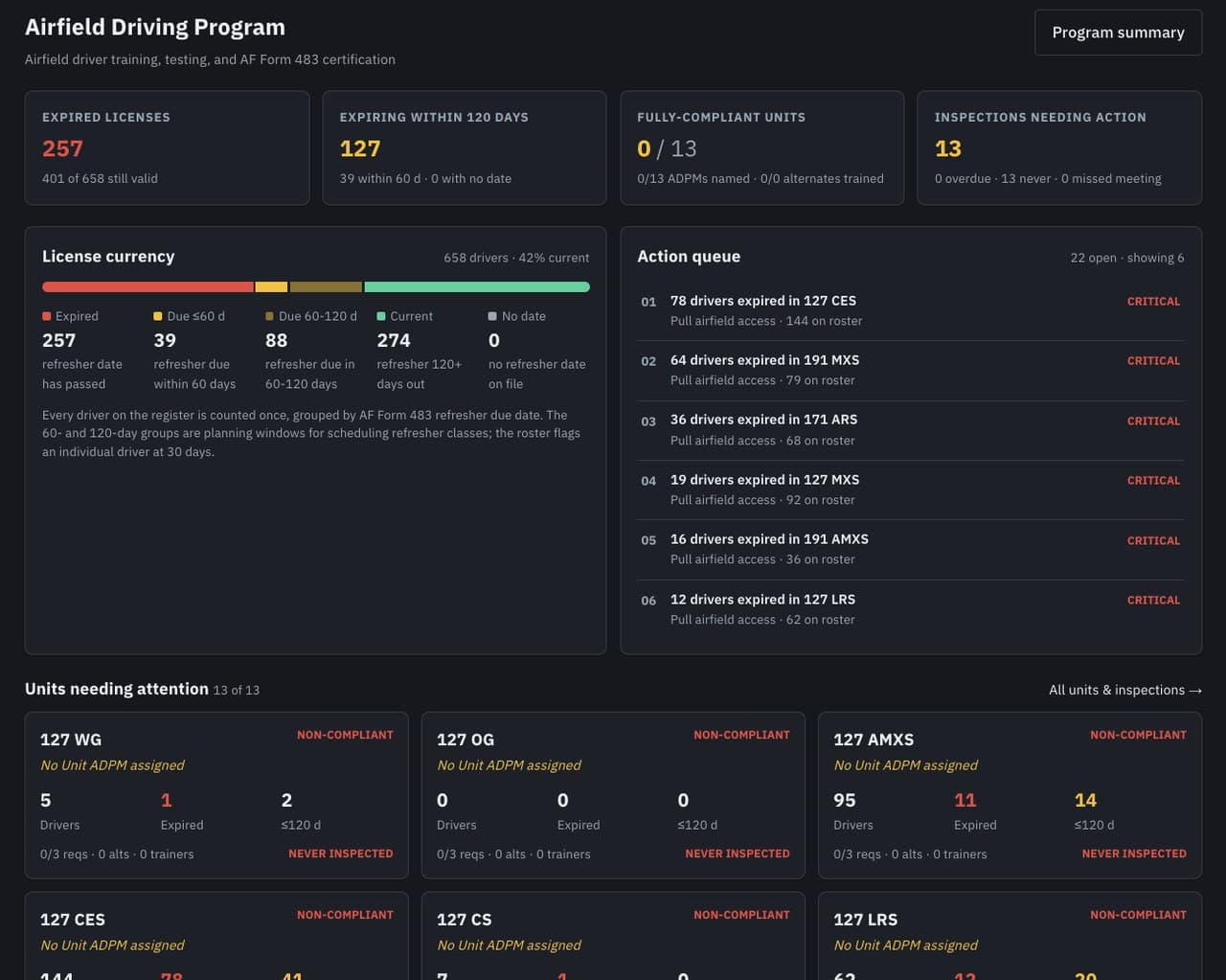
A wing-sized program scattered across spreadsheets and one-off CBTs
Every wing runs an airfield driving program, and most run it in pieces: a unit spreadsheet for the AF Form 483 roster, a one-off local CBT for the curriculum, a shared drive for Attachment 7 checklists, and ADTCS for the population that can reach it. The people who most need the training (contractors, tenant units, TDY personnel without CAC access) are the hardest to move through it.
And the program is graded on its records: appointment letters, training documentation, test security, the signature chain, license currency. When those live in five places, proving the program is current means assembling it by hand.
The whole program, appointment letters to license currency
Stand up units and appointments
Units, the Wing ADPM, Unit ADPMs, and trainers are appointed from the base's own user list, with the Attachment 4 appointment memorandum and the Attachment 5 training checklist generated straight from the record.
Trainees learn without needing accounts
A 12-module curriculum fills your airfield's own facts (callsigns, frequencies, tower hours) into every lesson, and a radio communications practical trainer grades each transmission by voice or keyboard. Trainees are records, not app users.
Proctored testing with enforced test security
Certification tests run in a locked full-screen session with server-side grading, randomly generated test versions with shuffled options, and the DAFI failure ladder (24-hour lockout, ADPM recommendation, commander approval) enforced by the database.
Certification ends in a license on the register
The Attachment 7 checklist and signature chain issue the AF Form 483 onto the register, with refresher tracking, violations on the DAFI consequence ladders, and Attachment 8 temporary permits for TDY personnel and contractors.
What it automates
Built for the people ADTCS can't reach
Contractors, tenants, and TDY personnel without CAC access complete training, sit a proctored test, and land on the register without ever needing an account.
Test security that runs itself
Generated versions, shuffled options, server-side grading, and a database-enforced failure ladder mean test integrity never depends on whoever is proctoring that day.
The register answers the currency question
Licensed drivers, refresher due dates, and per-unit compliance sit on one overview, with the Attachment 9 Tab E roster ready to hand a unit commander on demand.
Straight answers
Do trainees need Glidepath accounts?
No. Trainees are records, not app users: they complete the curriculum, sit proctored tests, and receive an AF Form 483 without an account. The module is built for the population that can't reach ADTCS.
How is test security handled?
Questions live in a managed bank. Generated versions draw randomized questions per audience with shuffled options and enforced question floors, answer keys stay server-side until submission, and multiple versions satisfy the Attachment 5 test-security measure.
What happens when someone fails a certification test?
The DAFI failure ladder is enforced by the database: a 24-hour lockout after the first failure, a Unit ADPM recommendation with documented remedial training after the second, and unit commander approval after the third.
Can existing rosters come in from ADTCS?
Yes. The ADTCS Import tab accepts Airfield Licenses, User Roles, and Enrollments exports, dropped in as .xlsx or pasted straight from Excel, so the register starts from what the wing already holds.
How are violations handled?
Recording a violation derives the offense number per subject and suggests the DAFI minimum consequence, editable under command discretion, with suspension windows, 483 surrender, and Wing Safety reporting tracked. Three runway incursions in a rolling six months raise the RIPWG banner.