
Military Airfields / AMTR
Airfield Management Training Record (AMTR)
The Airfield Management Training Record, fleet-wide: 623A signatures, 1098 tracking, records inspection.
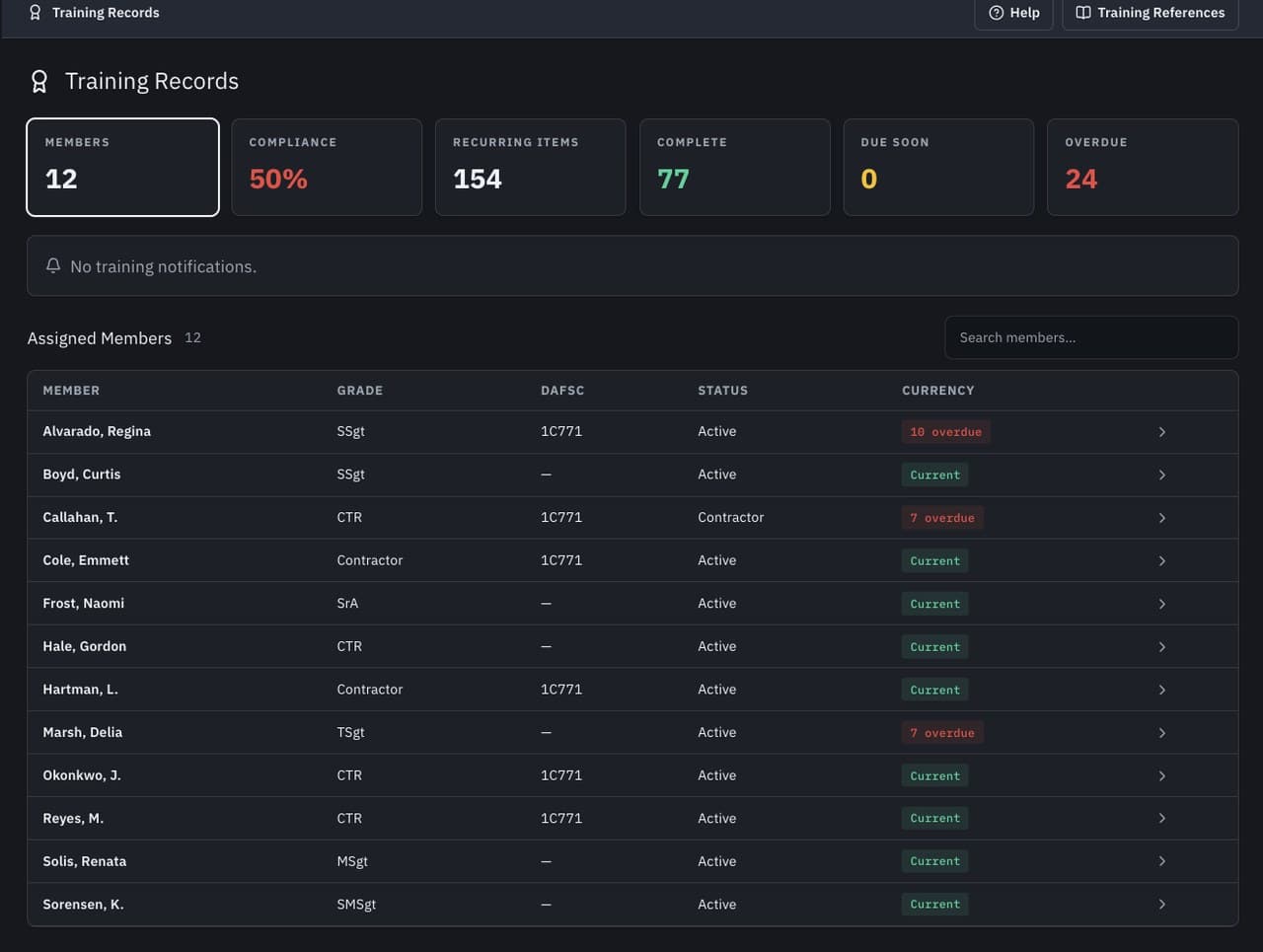
Fleet-wide training currency is a hundred small facts, per member
Who's current on which recurring task, whose 623A entries are signed and by whom, whose records inspection turned up a finding that never got closed. Multiply that across every member on the roster, and the honest answer to "are we current" takes real digging, not a glance.
The records inspection is itself a compliance record. If it isn't clear which findings are still open, or whether last year's gap got fixed, the inspection meant to prove currency becomes one more thing to track.
One roster, each member's record underneath it
The whole roster, one screen
Members, compliance percentage, what's due soon, what's overdue. The roster's KPI strip surfaces the fleet-wide picture, and clicking Due Soon or Overdue filters straight to the members behind it.
623A signs itself into the record
Signing off a 1098 task, a qualification item, or a milestone opens a linked 623A entry automatically. Each column (trainee, trainer, NAMT, Airfield Manager) is typed initials tied to the real signed-in account and a timestamp, not text entered under any name, and a signed block locks.
1098 tracking resets with the calendar
Recurring tasks are tracked per calendar year: this year's catalog is what's active and due, and a closed year archives read-only instead of cluttering the current one.
The records inspection grades what's current
A gap-scan pre-fills a records-inspection checklist against the member's real record (identity, qualification, 623A, 1098, milestones) and scores this year's 1098 currency specifically, not prior years sitting in the archive. A finding writes its own 623A narrative and an archived PDF the moment the inspection completes.
What it automates
Nobody tallies the roster by hand
Compliance percentage, due-soon, and overdue are computed and shown at the roster level, so nobody tallies individual member records by hand to find the gaps.
A signature can't be entered under someone else's name
Every 623A column ties back to the real signed-in account and a timestamp, with role hierarchy and a self-certification guard enforced on who can sign which column.
No separate write-up after the fact
A finding writes its own 623A narrative and an archived PDF the moment the inspection completes. The compliance record and the inspection are the same action.
Straight answers
Does the records inspection grade every year of 1098 tracking?
No. Only the current calendar year's 1098 catalog is scored. Prior years are archived, not re-graded, since they're no longer the active record.
What counts as a signature on a 623A entry?
Typed initials tied to the real signed-in account and a timestamp, both set server-side and impossible to fake, with role hierarchy and a self-certification guard enforced on who can sign which column.
How do I find out who's overdue across the whole roster?
The roster's KPI strip shows Due Soon and Overdue counts fleet-wide; clicking either filters the table straight to the members behind the number.
What happens when the records inspection finds a gap?
It writes its own 623A narrative (itemized findings, or "No discrepancies noted") and archives a PDF the moment the inspection completes, no separate write-up required.