
Military Airfields / Inspections
Airfield Inspections
Daily Airfield and Lighting inspections, Pre & Post Construction Inspection, and Joint Monthly Inspections, aligned to the requirements outlined in DAFMAN and UFC regulations.
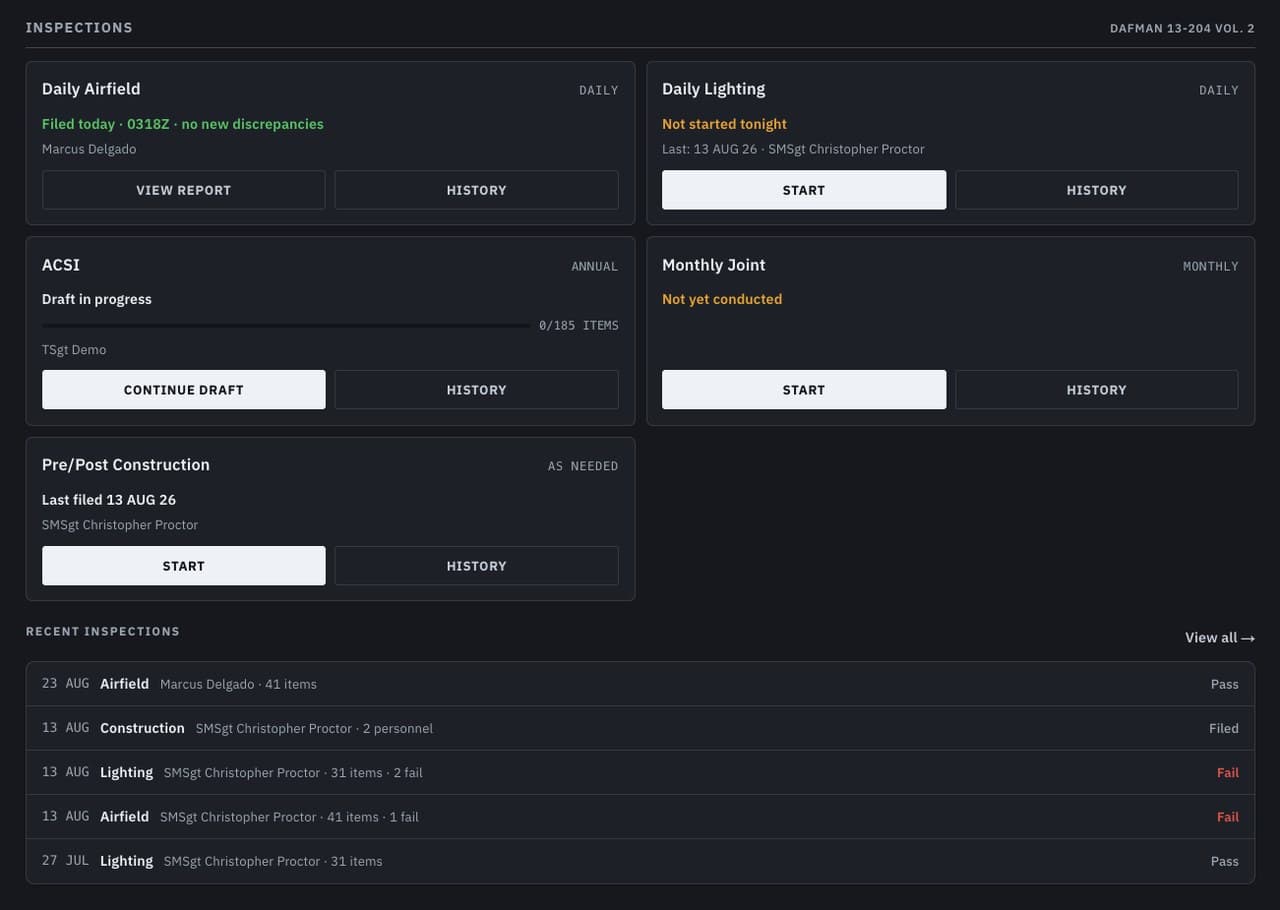
An inspection is only as good as what it catches, and what it proves afterward
A daily airfield or lighting inspection touches dozens of items (runway surface condition, bird watch condition, every light and marking), and the ones that matter are the ones marked wrong, not the ones that passed. Losing a failed item in a long list, or forgetting to log it before moving on, is how a real discrepancy goes unrecorded.
A construction or joint-monthly inspection isn't an item checklist at all (it's a record of who attended and what was discussed), so it needs its own format, not a checklist that doesn't fit the meeting.
Built around DAFMAN and UFC requirements
Work through the checklist, exceptions only
Click to document a failed item. Bird watch condition and runway surface condition are the two entries every airfield inspection requires; everything else, you only touch what's wrong.
A failed item opens its own record on the spot
Mark an item Fail and a discrepancy stub opens right there (a comment, a photo, a location) without leaving the inspection. Decide then whether to log it as a discrepancy; file the inspection and that decision is locked in.
Runway condition feeds the status board
Log a runway condition reading during the inspection and it carries straight through to the Airfield Status board. Nobody re-enters it a second time.
Construction and joint-monthly get their own format
These aren't item checklists: they're a record of who was there, what was covered, and the photos to back it up, filed in the same history as every other inspection.
What it automates
One inspection a day, highlighted on a user's dashboard
See at a glance whether the daily inspections are complete, who completed them, and who to reach if one is still in progress.
Exception marking keeps you moving
Every item defaults to Pass: you only stop to mark what fails, so a routine inspection moves as fast as it should.
A record that holds up
Export or email a completed inspection as a PDF report, attributed and dated, ready the moment anyone needs to see it.
Straight answers
Do I have to mark every single item, even the ones that pass?
No. Every item defaults to Pass. You only touch the ones that fail. Bird watch condition and runway surface condition are the two entries every airfield inspection requires.
What happens when I mark an item as failed?
A discrepancy stub opens right there in the inspection: add a comment, a photo, a location, and choose whether to log it as a discrepancy before you file.
Do construction and joint-monthly inspections use the same item checklist as the daily inspection?
No. Those are a different record (who attended, what was covered, and photos), filed alongside the daily inspections in the same history.
Can two people start the same inspection twice in one day?
No. Glidepath blocks a second same-type inspection for the same day, enforced in the app and backed by a database rule.