
Military Airfields / Airfield Checks
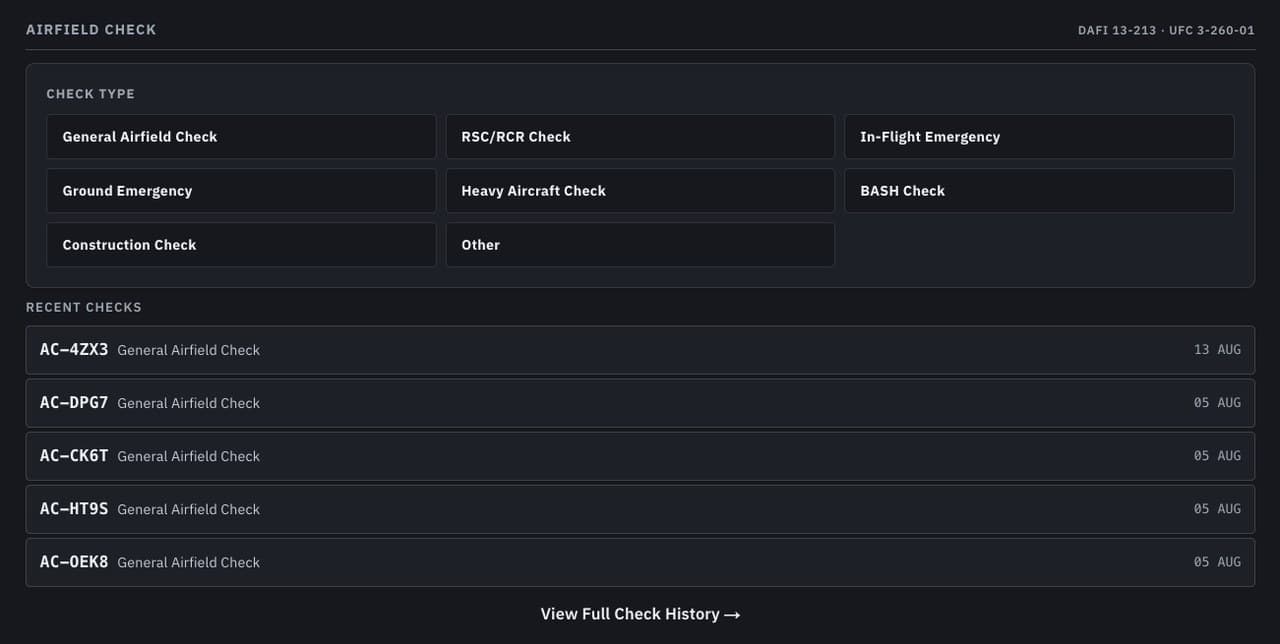
A different check for every situation, one place to run them
A FOD check, a BASH check, a construction check, an in-flight emergency response. Each covers different ground, and each needs its own record afterward. Treat them all like one generic inspection and the details specific to that check get lost; treat them as unrelated one-off write-ups and there's no shared trail of who ran what, and when.
And when a check turns up something wrong, the person running it shouldn't have to stop, switch tools, and describe the same problem a second time to get it into the discrepancy queue.
The right check, worked through start to finish
Start the right check for the situation
Pick the check type (FOD, BASH, construction, heavy aircraft, an in-flight or ground emergency, runway surface condition, or another situation entirely) and Glidepath logs you on the airfield and brings up the fields that check needs.
Work through what that check calls for
A construction check steps through an item-by-item pass/fail grid; an in-flight or ground emergency steps through its own action checklist; simpler checks take a direct entry. Every type ends the same way: Complete Check.
Flag a problem without leaving the check
Find something wrong mid-check and mark it on the spot (a comment, a location, a photo) and decide right there whether it becomes a discrepancy. Nothing gets re-described later.
Every check becomes a dated record
Completing a check produces a PDF record naming who completed it and when, archived in the check's history alongside every other completed check, searchable later by type, area, or date.
What it automates
The right fields for the right check
A construction check and a FOD check ask for different things, so nobody fills out fields that don't apply to their situation.
Picking the check logs you on the airfield, too
Choosing a check type logs you on the airfield and brings up the fields it needs, in the same step. Nothing separate to do first.
A complete history, not scattered write-ups
Every check type lands in the same searchable history, attributed to who ran it and when.
Straight answers
Do all check types work the same way?
They share the same start-to-finish shape (pick the type, work through what it calls for, complete it), but the fields in the middle are specific to that check. A construction check steps through an item-by-item grid; an in-flight emergency steps through its own action checklist.
If a check turns up a problem, does it automatically become a discrepancy?
You decide. Flag the issue with a comment, a photo, and a location right where you found it, then choose whether to log it as a discrepancy. Nothing forces the decision either way.
Is there a record of who completed a check?
Every completed check produces a PDF record naming who completed it and when, and it's archived in the check's history alongside every other check.
How is this different from the Shift Checklist?
The Shift Checklist is a separate, three-state daily checklist that resets each shift. Airfield Checks are the situational checks (FOD, BASH, construction, emergencies, and more), each with its own record.