
Military Airfields / Waivers
Airfield Waivers (AF Form 505)
The full waiver lifecycle with annual review: six classifications, seven statuses.
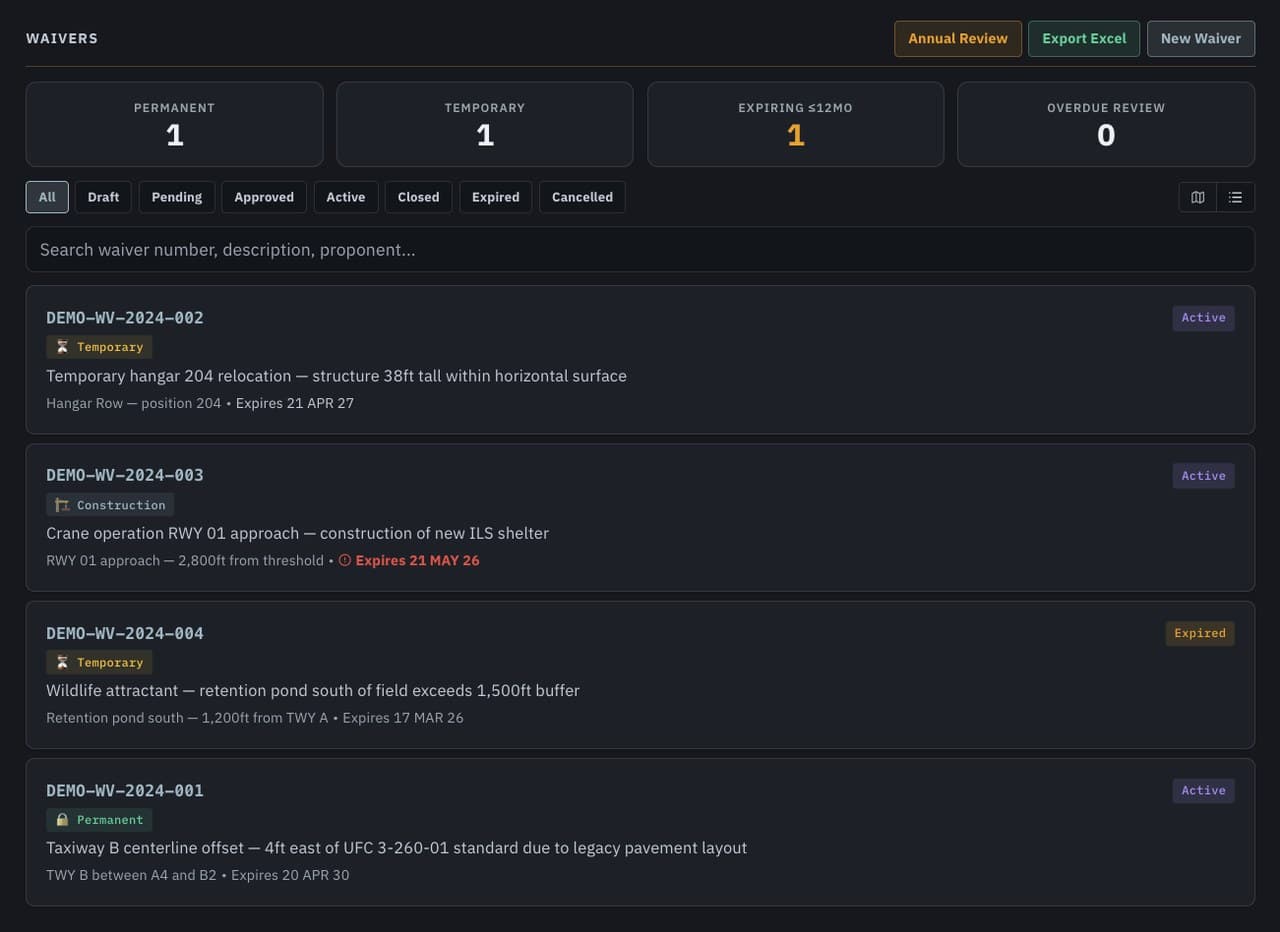
A waiver is a promise with a due date, and there are a dozen of them at once
Every waiver is a deviation from a standard, with its own justification, its own approval authority, and its own status. Track a handful of those by memory or by folder and the thing that slips isn't the waiver itself: it's the annual review a regulation requires on the ones still active, or an expiration nobody noticed until it passed.
And when a waiver needs updating, that history (who coordinated, what changed, when) has to survive the update too, not just the current status.
Every waiver, its whole lifecycle, in one record
Six classifications, one intake form
Permanent, Temporary, Construction, Event, Extension, or Amendment. Pick the classification and Glidepath brings up the matching 505-shaped form: justification, the regulatory paragraph being waived, approval authority, location, and supporting documents.
Status moves only where the lifecycle allows
A waiver can't jump from Draft straight to Active. The allowed transitions are built in, and every status change logs who made it and why to the waiver's own coordination history.
The annual review comes to you
Approved and active waivers are due a review every calendar year. Glidepath flags the ones approaching that date so the review happens before it's overdue, not after.
See it on the map, or work the list
Every waiver with a location drops a pin on a satellite map of the airfield, color-coded by classification, or filter and search the list. The same records either way.
What it automates
A waiver can't skip a step
Allowed status transitions are built into the record, so a waiver can't be marked Active without ever having been Approved. The history has to make sense because the app enforces it.
The annual review can't hide behind a filing system
An overdue review flags red in the list. A separate tile tracks waivers expiring within the next 12 months in amber, watching each waiver's own expiration date rather than its review date. Neither one depends on someone remembering to check.
Every status change keeps its own trail
Who coordinated a change, when, and what came of it logs to the waiver's coordination history automatically. The record shows its history, not just its current state.
Straight answers
What are the six waiver classifications?
Permanent, Temporary, Construction, Event, Extension, and Amendment. The classification picked at intake determines which fields the form asks for next.
Can a waiver's status change to anything at any time?
No. Only specific transitions are allowed (Draft can only move to Pending or Cancelled, for instance), so the status history can't end up contradicting itself.
Does Glidepath track the annual review requirement?
Yes. Approved and active waivers flag red once their review is overdue. A separate tile tracks waivers expiring within the next 12 months in amber, watching the expiration date rather than the review date, so neither one depends on memory.
Can I export a waiver, or all of them, for a submission?
Yes. Export a single waiver to a 505-formatted PDF, or export the full register to Excel for submission up the chain.