
Military Airfields / Read File
Read File
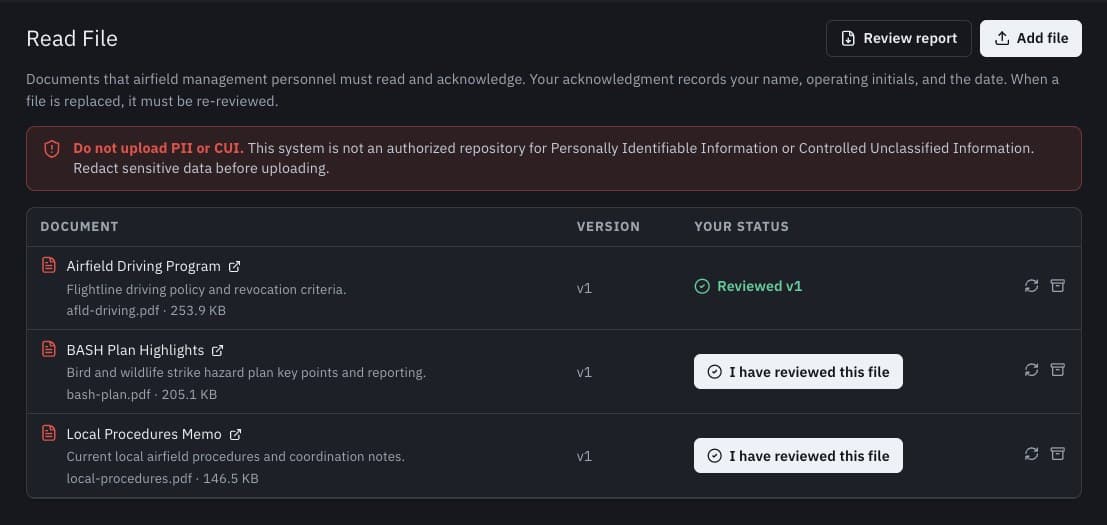
Routed files with tracked read-acknowledgment: who reviewed it, their initials, and the date, every time.
Required reading has no reliable proof it was read
A new driving program or an updated BASH plan goes out, and everyone's supposed to read it, but proving they did, who and when, usually comes down to a sign-in sheet or trusting that silence means yes.
It gets worse the moment the document changes. Revise the memo and every acknowledgment collected against the old version now describes a file nobody's supposed to be using, and nothing forces that gap to surface until somebody notices.
Every file, who's read it, and whether that read still counts
Every routed file, in one table
A driving program, a BASH plan, a local procedures memo, whatever's been added, shows in a single table with its current version number, instead of scattered across whatever inbox it was originally sent to.
One click, fully attributed
Clicking "I have reviewed this file" is what counts: it logs the reader, their operating initials, and the date against that exact version, right when it happens, with nothing to reconcile against a separate sign-in sheet.
Replace the file and every acknowledgment resets
Upload a new version and the acknowledgments on record stop counting for it. Whoever already read the old one has to review the new version before they show current again.
A review report that names names
Review report exports a PDF scoring every document against every required reader: reviewed or outstanding, each one dated and initialed the moment it's done.
What it automates
Required reading has a record behind it
Every acknowledgment is tied to a name, a set of operating initials, and a date, against the exact version of the document that was read.
A new version can't inherit an old read
Replace a file and its acknowledgments go with it: whoever signed off on the version before is back to outstanding until they open the new one.
Compliance is a generated report, not a roundup
Instead of asking around, run Review report: one PDF, every document, every required name, marked reviewed or still outstanding.
Straight answers
What does acknowledging a file actually record?
Clicking "I have reviewed this file" logs three things: the reader, their operating initials, and the date, tied to that exact version.
What happens to acknowledgments when a file gets replaced?
They stop counting. A new version uploaded over the old one puts everyone back to outstanding until they review it again, regardless of what they'd already acknowledged.
How do I see who still owes a read?
Generate Review report. It's a PDF that scores every required reader against every document, reviewed or outstanding, each one dated and initialed once it's done.
What kinds of files can I upload?
PDF, a scanned image, an Excel sheet, or a Word file, up to 25 MB, and a separate action swaps in a new version whenever one needs updating.