
Military Airfields / QRCs
Quick Reaction Checklists (QRCs)
Quick Reaction Checklists ready at the moment of the emergency: 25 checklists, eight step types.
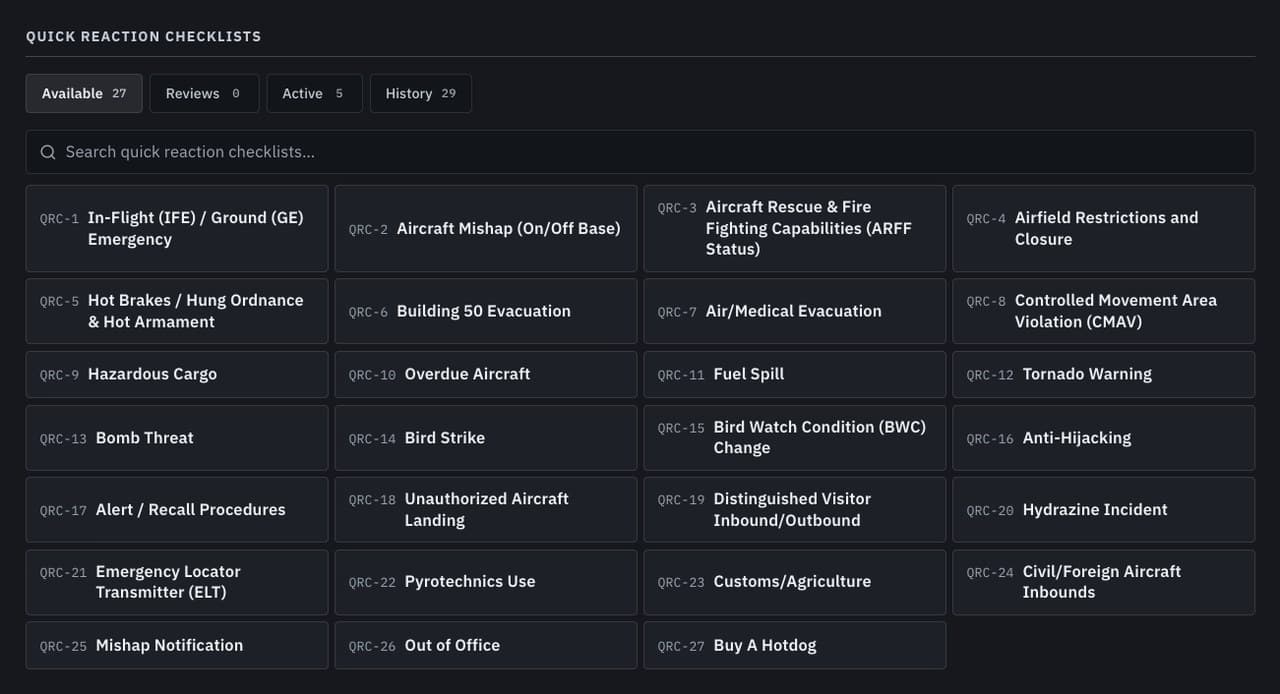
An emergency checklist is only as good as the version everyone's reviewed
Twenty-five checklists is a lot to keep current by memory, and the moment one gets used is the worst time to discover a step referencing something that changed months ago, or that this cycle's review never happened.
Running a checklist for real is also different from reading it. A phone list to work through, a time to log, a field to fill in: none of that is worth much afterward without a record of what was done, by whom, and when.
25 checklists, eight step types, a live run when it counts
Every checklist's status, at a glance
The grid lists every checklist by number and title, each showing its step count and whether it's been reviewed this cycle, gone overdue, or never been touched, with a plain flag if the checklist itself changed since your last look.
Eight step types built for what an emergency needs
A checkbox, a checkbox with a note, a fill-in field, a time entry, an agency to check off as notified, a branch to another checklist entirely, or a block of instructions to read, whichever the moment calls for.
Opening one to run it is a real, logged event
Starting a checklist begins a live execution: every step is saved as it's completed, timestamped and attributed, not just checked off and forgotten.
Review compliance rolls up, it isn't assumed
Each checklist keeps its own review clock, and a compliance report pulls every Airfield Manager's status into one PDF: who's current, who's overdue, and which checklists have gaps.
What it automates
The grid shows what's current
Reviewed, overdue, or never touched: a checklist's review status is visible before you open it, not something you find out by asking around.
Running a checklist leaves a record behind
Every step of a live execution saves with who completed it and when, so what actually happened during the event is still there afterward.
Compliance is a report, not a project
One PDF rolls every Airfield Manager's review status against every checklist into a single picture. Nobody assembles that by hand before an inspection.
Straight answers
How many checklists are there, and what do they cover?
25, spanning the range of required quick reaction procedures, each built from eight possible step types, from a simple checkbox to a branch that hands off to another checklist entirely.
Is opening a checklist the same as just reading it?
No. Opening one to run it starts a real, logged execution. Each step is saved as it's completed, with who completed it and when, not just viewed and closed.
How does Glidepath track whether checklists have been reviewed?
Two ways: each checklist itself flags when it's due for its own review, and each Airfield Manager has a personal review cycle, monthly by default, so a checklist current for one person can still show as due for another.
Can I get a report of who's reviewed what?
Yes. A compliance report rolls every Airfield Manager's status against every checklist into one PDF, showing who's current, who's overdue, and where the gaps are.