
Civilian Airports / PPR
Prior Permission Required (PPR)
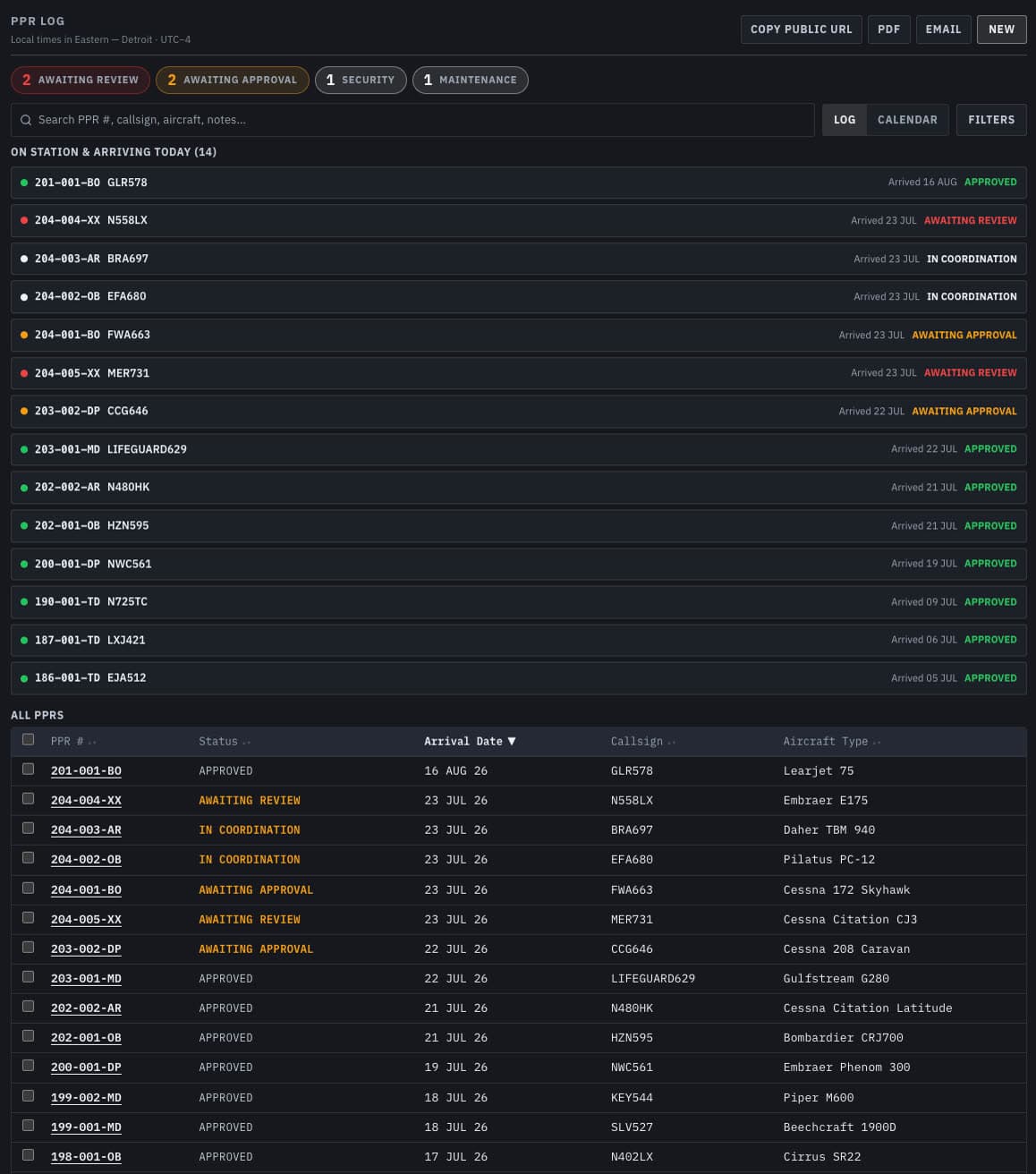
Prior Permission Required requests from public form to approval, with a clean audit trail.
A stranger's plans for your airport exist before your airport hears about them
An operator who needs prior permission to arrive, park, or work the field has no way to know, up front, whether a request will land with the right desk, whether every office that ought to weigh in will see it, or whether an answer arrives before the date they're asking about.
Add a second or third office to the mix (a tenant, a service provider, an adjacent agency), and simply knowing who has responded and who hasn't turns into its own tracking exercise, separate from handling the requests themselves.
A public form feeds a queue that can't quietly go silent
Submitting one needs no account
A requester provides how to reach them, the aircraft they're flying, and the date they need. Nothing to install, nothing to learn beforehand.
A new submission opens in review, not a mailbox
From there, staff decide whether the request needs other offices to weigh in, clear it directly when it doesn't, or turn it down. Whoever asked gets word back on the outcome.
No single office can stall the whole thing quietly
Add a second or third office to a request and each one gets its own notice and its own place to log a yes or a no. The request holds in coordination for as long as any of them hasn't answered.
One entry carries the whole history
Contact details, status, and the coordination trail sit on the same entry, so exporting one request (or the entire filtered list) to a PDF takes a click, not an assembly job.
What it automates
The requester doesn't need an org chart
One public form covers everything a request needs to start; sorting out which offices see it happens on Glidepath's side, not the requester's.
Silence doesn't read as agreement
An office that hasn't responded keeps a request in coordination: approval waits for an actual answer instead of an assumed one.
The export is whatever the entry already holds
Contact information, decision history, and coordination notes travel together on one record, so a PDF pull needs no separate pass to gather anything.
Straight answers
Once a request lands, who decides whether other offices need to weigh in?
A new submission goes to staff for a first look. They decide whether it needs input from other offices, clear it on the spot if it doesn't, or turn it down. Either way, the requester gets word back.
Can a single office (an FBO, a tenant, another agency) sit on a request without anyone noticing?
No. Add an office to a request and it gets flagged for that office specifically, with its own space to record a yes or a no. The request doesn't clear coordination until every one of them has weighed in, so silence never counts as an answer.
Does an operator need an account before submitting a request?
No. The form itself only takes a way to reach the requester, which aircraft is inbound, and the date needed. Nothing to install or set up beforehand.
What comes out when a request, or the whole log, gets exported?
Everything already on the entry: contact details, status, and the full coordination trail, packaged into a PDF in one step, whether it's a single request or the entire filtered list.