
Military Airfields / Traffic Log
Airfield Traffic Log
The live flight log: flight plan on one side, actual times on the other, and an alarm for anything that should have landed and hasn't.
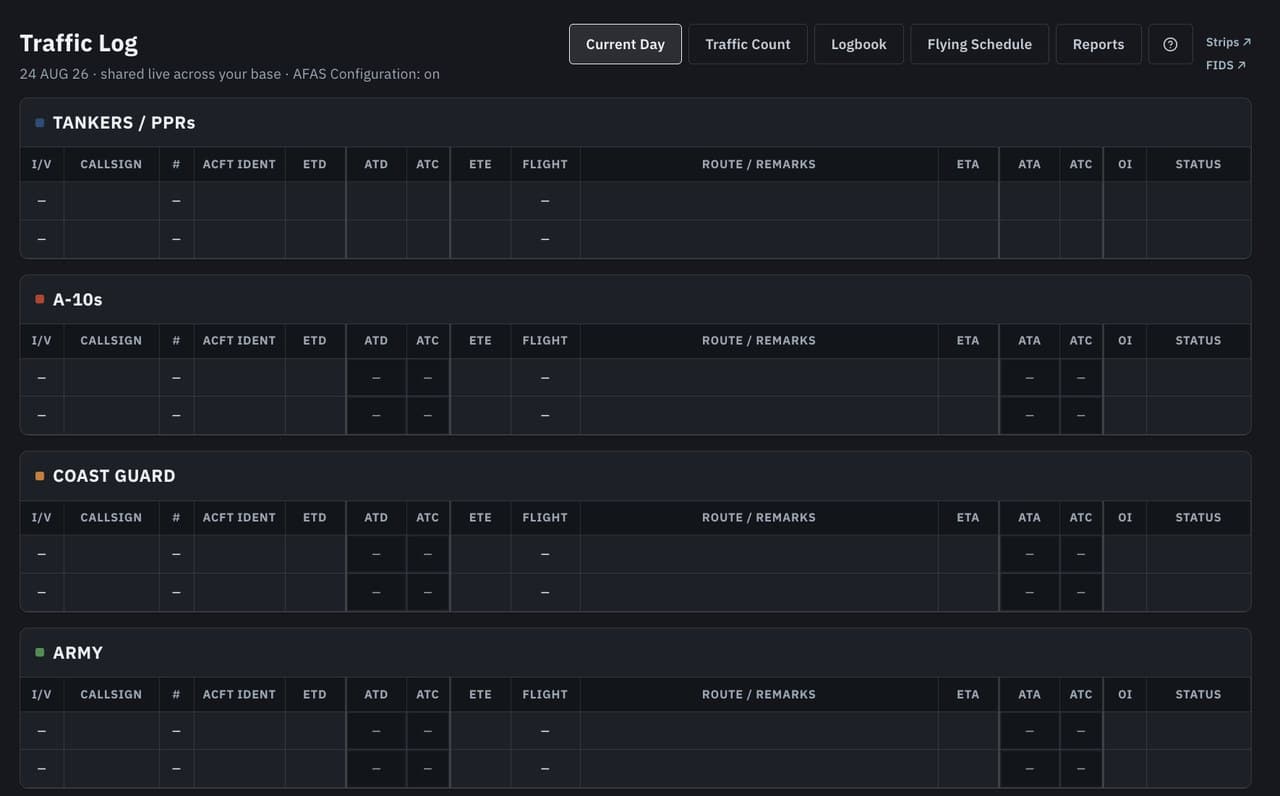
One day of flying, kept in three different places
The flight log lives in a shared spreadsheet at the ops desk, the tower keeps its own strips, and anything public-facing gets retyped a third time. Every copy drifts from the others the moment the day gets busy, and reconciling them afterward is its own job.
And the question the log exists to answer (is anything overdue right now?) depends on somebody doing mental math against the clock. An aircraft past its ETA looks exactly like every other open line until a person notices.
One live log, from flight plan to filed day
The flight plan on the left, the actuals on the right
Each category card ends in a blank row: type the callsign, pick the aircraft from a search over 2,702 FAA designators (your base's last 90 days float to the top), set the flight type, and record actual times as they happen. Every keystroke persists; there is no save button.
The ETA computes itself
ETA fills in from ETD plus ETE, then re-derives the moment a departure is recorded. Everything on the log runs Zulu: the times, the day boundary, the date in the header.
An overdue aircraft raises its own alarm
Five minutes past ETA turns the row amber; past 30 minutes it goes red and a pop-up blocks until answered. Acknowledge quiets it base-wide, and one press starts your linked overdue-aircraft QRC, one execution per flight, labeled with its callsign.
The same entry feeds the tower and the lobby
Flight Strips is the tower's working board: with AFAS Configuration on, the tower types the departure and arrival times and the log shows them read-only. FIDS is the public lobby display, written plain for readers with no aviation background. Both run on their own kiosk links.
What it automates
Overdue detection is a rule, not a habit
The two-tier alarm runs on every qualifying row against the Zulu clock. Only a recorded arrival or a corrected ETA clears it, so a quiet screen means nothing is waiting.
Traffic counts generate themselves
Movement tallies by aircraft identifier and by pavement group, counted on the date each actual happened, with a Traffic Count PDF and a sixteen-column Daily Logbook PDF on demand.
The day closes itself
Close Day fires automatically at your Zulu rollover: still-open flights carry forward once, finished days stay readable in the Logbook calendar, and nothing needs archiving by hand.
Straight answers
What happens when a flight goes overdue?
Five minutes past ETA the row turns amber; more than 30 minutes past it turns red and a pop-up lists every unacknowledged overdue flight. You can snooze it five minutes on that device, acknowledge it for every screen at the base, or start the linked overdue-aircraft QRC directly from the pop-up.
Can the tower enter the actual times?
Yes. With AFAS Configuration on, the Flight Strips board feeds the ATD, ATA, and controller initials, and those cells go read-only on the log itself. With it off, the desk types the actuals straight onto the grid.
What does the public lobby display show?
FIDS is written for readers with no aviation background: no initials, no shorthand, no route text, and no overdue markers. Recorded times show green, estimates grey, under a live Zulu clock. Which categories reach it is a per-category setting.
How does a day end?
Close Day runs itself once Zulu time passes your configured rollover. Still-open flights move forward one day, exactly once, and every finished day stays readable in the Logbook, including its PDF.
Which flights can trigger the overdue alarm?
Any active flight with a parseable ETA except an outbound, which never arrives back. Types that depart your field first (local, round robin, pattern) stay quiet until a departure time is recorded; an inbound alerts on its ETA alone.